
Card technology · 11 min read
Secure card printing: options to prevent counterfeiting
Counterfeiting risk on a B2B card is rarely about geopolitical fraud — it is about gift cards being duplicated, employee badges being forged, member cards being shared, access cards being cloned. This guide covers the visible, tactile and encoded security layers available on custom PVC and paper cards, when each layer makes sense, and how to combine them in a way that matches the actual risk profile of your card programme.
1. Short answer: matching security to risk
Secure card printing is layered defence, not a single silver-bullet feature. The strongest single layer available today is the smart card chip with mutual authentication and encryption (Mifare DESFire EV2/EV3, Java Card with PKI) — the data itself becomes the protection and a visually duplicated card is rejected by the reader because it cannot prove possession of the keys. Around that core, three complementary tiers add depth: visible deterrents (hot foil, spot UV, signature panel — anyone can see they are there), tactile and structural features (embossing, lamination, scratch-off — they shift the cost of counterfeiting from art software to industrial press equipment), and variable data identification (unique QR per card, unique barcode, sequential numbering, photo personalisation — each card is single-card traceable).
The right combination is dictated by the value at stake. A neighbourhood café's stamp loyalty card needs no security beyond the printed brand. A premium hotel's member card needs visible deterrents plus per-card serialisation. A corporate access badge protecting a server room needs an encrypted smart card chip with mutual authentication. Calibrate the toolkit to the actual risk — not to a generic "high security" wish list.
2. What "secure card printing" actually means
In a B2B card programme, "secure" rarely means resistant to a determined nation-state attacker. It means raising the cost, time and equipment threshold for the attacker types you actually face — a customer trying to share a member discount with a friend, a former employee whose badge was not collected, an opportunistic counterfeiter printing fake gift cards on a home inkjet. Each of these has a different bar, and each is defeated by a different mix of features.
The toolkit splits across three independent axes:
- Visible features — the eye sees them at a glance. They establish authenticity at the till, at the door, at the front desk. Their value is partly deterrence (the counterfeiter knows the staff will spot a fake) and partly verification (the staff has a quick visual checklist).
- Tactile and structural features — the hand or the equipment feels them. They shift the production cost from a flatbed printer (which any office has) to specialised press equipment (which a counterfeiter must source).
- Encoded features — the data is the protection. The card body can be reproduced visually, but the encoded payload (chip cryptography, sector keys, serialised UID, magnetic coercivity) cannot — short of compromising the issuing system itself.
A robust card programme typically uses two or three layers from across the axes, not five layers from one. For the underlying card materials and print process, see our guides on what PVC cards are and custom PVC card printing.
3. Visible security features (tier 1)
Tier 1 features are the public-facing security signals. They are visible at the till, at reception, at the door — and their role is dual: they raise the bar for the counterfeiter (specialist equipment required) and they provide staff with a quick authentication checklist.
3.1 hot foil stamping
A metallic foil — gold, silver, copper, rose-gold or holographic — pressed onto the card surface with a heated die. The result is a high-shine reflective element that no inkjet, no laser printer and no flat-toner press can reproduce. Hot foil is the most widely used visible security feature on premium cards: it is unmistakable, it ages well, and the equipment required to reproduce it (a foil stamping press) is industrial-grade. See the finishes and customisation options page for the available foil colours.
3.2 spot UV varnish
A clear, glossy UV-cured varnish applied to selected areas of the card surface. Spot UV is visible under angled light (a reflective patch on an otherwise matte card) and tactile to the touch. Like foil, it is industrial-grade — the cured varnish texture cannot be reproduced by a home printer. Often combined with foil on premium cards to layer two visible signals.
3.3 signature panel
A white writable strip on the back of the card — sized for a personal signature in ballpoint or fineliner. The signed strip is a manual authentication element: staff can match the card's signature against an ID or against a previous transaction signature. Signature panels also reveal tampering: any attempt to lift or alter the signature mark leaves visible disturbance on the panel surface. Standard on premium PVC member cards and corporate identification.
3.4 premium substrates and finishes
Transparent or frosted PVC, soft-touch lamination, metallic or pearlescent inks, edge-painted triplex paper — these are not security features in the strict sense, but they raise the visible quality threshold to a level that ad-hoc counterfeits cannot credibly match. A frosted PVC card with foil stamping printed at a home office "looks wrong" in a way that even a non-expert recognises. See PVC card range and paper card range.
4. Tactile and structural security (tier 2)
Tier 2 features shift the counterfeiting cost from graphics software to industrial press equipment. They are not visual at a glance — they are felt, or they are revealed only through specific physical actions.
4.1 embossed serialised numbering
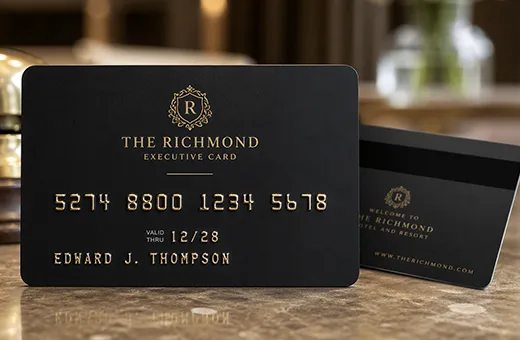
Raised characters on the front of the card, formed by mechanically deforming the PVC substrate from the back. Embossed numbering carries a unique cardholder identifier — a member number, an account reference, an ID — that is permanent and impossible to alter without destroying the card body. Critically, an embossed number cannot be photocopied: the raised relief is invisible to a scanner or a phone camera capturing a flat image, which makes embossing one of the strongest anti-counterfeiting features on a PVC card. Available on selected product families, including our membership cards, identification badges, smart cards and magnetic stripe cards ranges as a variable data feature.
4.2 tamper-evident lamination
The protective lamination layer applied across the PVC card surface bonds permanently to the substrate during the heat press phase. Any attempt to delaminate the card (to swap a photo, to alter printed text) leaves visible disturbance — clouding, edge lifting, ink transfer onto the lamination film. The lamination itself is therefore both a protective layer for daily use and a passive anti-tamper signal. Used systematically on all PVC ID and member cards.
4.3 scratch-off ink
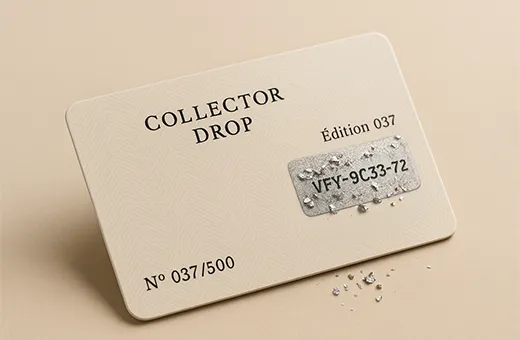
A removable silver or grey layer printed over a printed code (typically an activation PIN, a redemption number, a one-time token). The customer scratches the layer off to reveal the code. The act of scratching is irreversible: a missing or partial scratch-off layer signals that the card has already been activated, which makes scratch-off a tamper-evident feature for gift card activation, promotional codes and one-time-use redemptions. See our PVC gift cards and paper gift cards pages.
4.4 multi-layer triplex (paper cards)
Triplex paper stock — three layers bonded into a single 600+ gsm card — produces a substantially thicker card body with a coloured central layer visible only on the painted edges. The construction is non-trivial to replicate without specialist paper press equipment, which raises the counterfeiting bar for paper-only programmes. Used on premium paper business cards and high-end paper membership cards.
5. Encoded security (tier 3 — the strongest defence)
Tier 3 is where the data — not the card body — becomes the protection. The card surface can be cloned visually, but the encoded payload cannot be reproduced without access to the issuing keys or system. Encoded security is where modern card programmes carry their hardest defences, and the smart card chip is the single most powerful layer available today. Visible and tactile features deter casual fraud; the encoded chip stops cloning at the protocol level.
5.1 smart card cryptography — the centrepiece
A modern smart card carries a secure element — a tamper-resistant microchip — that supports mutual authentication, AES-128 encryption, certificate storage and protected sector keys. When the card is presented to a reader, the two sides exchange a cryptographic challenge: the chip proves it holds the secret without ever revealing it. A counterfeit card that reproduces the printed surface perfectly still fails this exchange and is rejected at the reader. This is fundamentally different from any visible or tactile feature — visual features can be replicated with enough effort; a properly-deployed cryptographic chip cannot.
The chip families chosen for security depend on the protocol the reader expects:
- Mifare DESFire EV2 / EV3 — the modern reference for secure access and transit. AES-128 encryption, mutual authentication, AID-based application separation. Not practically cloneable.
- Java Card with PKI — programmable chip running Java applets, used for e-government, qualified electronic signature and enterprise PKI. Certificate-based authentication, highest assurance level available on a card.
- Dual interface (contact + contactless) — bank-grade chip with both a visible contact pad and an internal antenna sharing one secret store. Standard on modern bank cards and high-security corporate badges.
- NTAG NFC chips (213/215/216) — lower assurance, smartphone-friendly. Useful when the threat model is duplication-deterrence rather than cryptographic attack.
For any programme where the card unlocks something of value — a building, a bank account, a member benefit worth defending — the smart card is the right starting point, and the other tiers wrap around it. For the chip family decision tree, see our companion guide what is a smart card and the comparison magnetic stripe vs smart cards.
5.2 magnetic stripe HiCo coercivity
The two coercivity standards on magnetic stripe cards have different security profiles. HiCo (2750 or 4000 Oersted) is the permanent-encoding standard — resistant to accidental demagnetisation and to casual erasure attempts. LoCo (300 Oe) is rewritable by design (for gym day passes, library cards). For any application carrying valuable data on a magnetic stripe, HiCo is the correct choice. See magnetic stripe cards.
5.3 programmed sector keys and UID
On Mifare and similar chip families, the card's unique identifier (UID) is read-only and factory-fixed. Specific sectors of the chip can additionally be protected with custom sector keys defined at programming. A reader that does not hold the correct sector keys cannot decode or write the protected data — even if it can read the UID. This two-level protection (factory UID + customer-defined sector keys) is the standard pattern for corporate access cards and transit cards.
5.4 dual interface (chip + contactless)
A single secure element with two interfaces — a contact chip pad on the front and a contactless antenna inside the card body — sharing the same cryptographic store. Used on modern bank cards and on high-security enterprise badges where a single card must work at both contact terminals and contactless gates. The dual interface is one card, one secret store, two ways to access the data — and both interfaces benefit from the same cryptographic protection.
6. Variable data identification — every card uniquely identifiable
A card programme where every card is visually identical is impossible to trace. A card programme where every card carries unique identifying data — a different QR code, a different barcode, a sequential number, a personalised photo — is a programme where every card is single-card traceable: if one is lost, misused or counterfeited, the issuing system knows exactly which card and can invalidate that specific identity without disrupting the rest of the run.
Variable data is therefore not an aesthetic option — it is a foundational security primitive. Four variable data techniques carry the bulk of the load in B2B card programmes, and most cards combine two or more of them.
6.1 unique QR code per card
Each card carries a different QR code, generated row-by-row from the production data file. The QR can encode a unique URL (one landing page per card, used for digital activation, mobile redemption or member portal login), a signed token (a cryptographically unique payload that the backend validates), or a plain identifier (member number, voucher code). Because every QR is different, a counterfeit replicating one specific card cannot mass-produce — each replica still resolves to the same single record, which the system can lock. QR is the most flexible identification primitive on a printed card surface. See our companion guide on barcode and QR cards for business.
6.2 unique barcode per card
Each card carries a different 1D barcode (EAN-13 or Code 128) printed on the back or the side. The barcode is the bridge to the POS scanner or the access reader — scanning identifies the specific card, the backend system looks up the matching record, and any action (loyalty points, gift card balance, member access) is logged against that single identifier. Duplicate cards carrying the same barcode are detected the first time the second card is scanned: the system sees a barcode that has already been redeemed or marked active, and flags the duplicate.
6.3 sequential printed and embossed numbering
A serial number — printed on the card surface, optionally embossed as raised characters on premium product families — is the oldest and most universal identification primitive. Two flavours, often combined:
- Printed serial — a sequential or randomised number printed on the card front or back. Universal, machine-readable by OCR if needed, but reproducible by photocopy.
- Embossed serial — raised characters formed by mechanically deforming the PVC substrate. Tactile, not photocopiable, permanent. Available as variable data on selected PVC product families (membership cards, identification badges, smart cards, magnetic stripe cards).
Embossed numbering pairs particularly well with smart cards: the embossed printed number matches the encoded chip UID, so a visual check at reception confirms the card identity, and the chip provides the cryptographic proof at the reader.
6.4 photo personalisation (variable photo + name + ID)
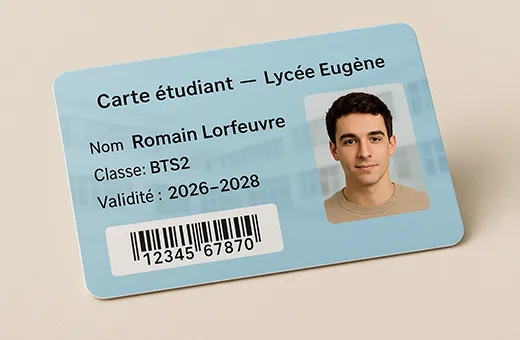
Each card prints a personalised face photo of the cardholder alongside their name and a unique ID number — all three pulled card-by-card from a structured data file (CSV + photo folder). The face photo is the most powerful single anti-impersonation feature on a card: even if the visual card body and the encoded chip are perfectly replicated, the photo does not match the person presenting it, and the visual mismatch is detected by reception, security staff or any human authentication checkpoint. Photo personalisation is standard on student ID cards, corporate ID badges, premium membership cards and event credentials.
6.5 combining the four — independent verification channels
The defensive value compounds when the same card carries multiple unique identifiers wired to the same backend record: a unique QR code, a unique barcode, an embossed unique serial, a personalised photo. A counterfeit must replicate all four independent channels consistently — and any single mismatch (the photo does not match the bearer, the QR resolves to a locked record, the barcode has been used) triggers detection. For the production workflow behind unique-per-card data, see variable data card printing.
7. Combining layers — the real defence
Single features are individually defeasible. Hot foil exists on every premium chocolate box — counterfeiters can buy foil stamping equipment. Embossing exists on every bank card — counterfeiters can buy embossing presses. Chip cryptography is only as strong as the key management around it. The defensive value comes from the combination — the cost of acquiring and operating all the equipment needed to fake the specific feature set of your card.
Three typical security stacks for B2B card programmes:
7.1 corporate access badge (smart-card-led — strongest profile)
Smart card with Mifare DESFire EV3 and custom sector keys + dual interface antenna + variable data printed name and personalised photo + embossed unique ID number + tamper-evident lamination. The encrypted chip is the actual access credential — the protocol prevents cloning. The variable data photo + name + serial support manual authentication at reception. The embossed number adds non-photocopiable serialisation. Used on corporate buildings, secure facilities, server rooms, premium banking and any programme where the card unlocks something of real value.
7.2 premium member card (visible + encoded combination)
Hot foil stamping + spot UV + signature panel + serialised printed numbering + contactless smart card chip + unique QR code per card for the digital member portal. The visible elements signal premium positioning and support manual checks at the till; the chip handles digital access and authentication; the QR connects to the mobile app. Used on premium hotel loyalty, private club cards, banking VIP cards.
7.3 gift card (anti-duplication, identification-led)
Hot foil branding + scratch-off activation code + unique barcode per card + unique QR code + variable data printed serial. Each card carries a different identifier on every channel, so the system tracks single-card usage end-to-end. The visible foil signals the brand; the scratch-off prevents pre-activation; the unique barcode and QR mean every card has a single redemption path. Used across retail gift card programmes — see PVC gift cards and barcode cards for business.
8. Sector-specific security profiles
8.1 banking and financial services
The strictest profile: dual interface chip with full cryptography, hot foil branding, embossed cardholder name and number, signature panel, hologram (where supplied externally). Member cards for premium banking tiers add spot UV and metallic finishes. See the banks and financial services industry page.
8.2 corporate access
Encrypted chip (Mifare DESFire EV2 or EV3) with custom sector keys, variable data photo + name printing, tamper-evident lamination. For multi-site organisations, a chip-only solution is typical — the visible card design is secondary, the encoded credential is the security. See corporate card programmes.
8.3 education (student and faculty IDs)
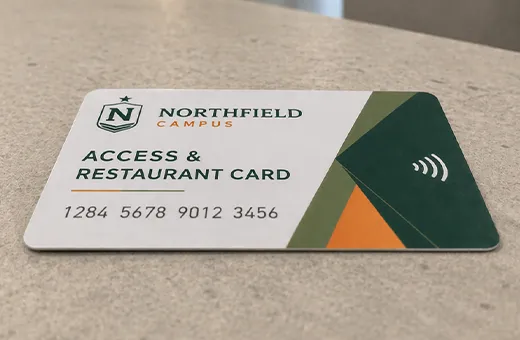
Photo printing + variable serial + chip encoding for campus access + signature panel for manual checks. The combination carries enough security for campus operations without bank-grade overhead. See student ID cards and the education industry page.
8.4 hospitality (member, VIP and gift programmes)
Hot foil + signature panel + serialised numbering on premium member cards. Magnetic stripe HiCo encoding for room access. Scratch-off activation on gift cards. The visible quality signals premium positioning and creates the deterrent. See the hospitality industry page.
8.5 retail loyalty and gift
Unique barcode or QR per card + scratch-off activation on gift cards + foil branding on premium tiers. The security threshold is calibrated to the unit value: a €10 gift card needs less protection than a €500 corporate gift voucher. See retail industry page.
8.6 events and conferences
Unique QR per attendee + role-specific colour coding (speaker, attendee, staff, VIP) + variable name printing. Event security is short-cycle (one or a few days) so the threshold is lower — the QR uniqueness and the visible role indicator together are usually sufficient. See events industry page.
9. Common security mistakes
- Treating "security" as one feature — adding hot foil to a card with no serialisation, no encoding and a photocopiable layout solves visual signalling but leaves data unprotected. Layered defence is the rule.
- Over-investing on the wrong tier — bank-grade chip cryptography on a coffee shop loyalty card is cost-disproportionate. Bringing only spot UV to a corporate access programme is under-investing. Calibrate to the actual risk.
- Skipping serialisation — every premium card programme needs single-card traceability. A serial is the cheapest, most useful security primitive.
- Trusting the visible alone — visible features deter casual fraud but cannot prevent determined counterfeiting at scale. For programmes with real value at stake, encoded protection is non-negotiable.
- Using LoCo magnetic stripe for permanent data — LoCo is rewritable by design. Any application carrying valuable data on a magnetic stripe needs HiCo coercivity.
- Using Mifare Classic for new secure deployments — Crypto-1 has known vulnerabilities. For new programmes, DESFire EV2 or EV3 is the modern default.
- Reusing serial codes across renewals — when a card is reissued, the serial should change. Reusing the old serial defeats the traceability the serial is meant to provide.
- Storing sector keys in shared documents — chip security depends on key management. Sector keys must live in your access control system, not in a spreadsheet circulated to staff.
- Forgetting the tamper-evident lamination — without lamination, a card body can be physically modified post-issue. Standard PVC lamination is a small cost for a meaningful integrity benefit.
- Not testing counterfeit scenarios at proof stage — print a sample, photocopy it, and see what survives. The exercise reveals which features actually defeat the casual counterfeiter.
10. Frequently asked questions
Can a custom card be made photocopy-proof?
Fully photocopy-proof is unrealistic, but several features are not photocopiable: embossed numbering, raised foil stamping, spot UV varnish texture, chip-encoded data, magnetic stripe data, signature panel signing. Combining two or three of these features defeats casual photocopy attempts decisively.
Is embossing always a security feature?
When used for variable serialised data — yes. An embossed unique member number on each card is tactile, non-photocopiable and impossible to alter without destroying the card body. Static embossing (the same logo embossed on every card) is decorative, not security. Embossing is available on Lumacards on selected product families as a variable data feature.
Are holographic stickers an option?
Holographic effects can be produced through holographic hot foil stamping, which gives a moving rainbow surface on selected areas of the card. True holograms applied as standalone stickers are a separate supply chain — discuss the specific requirement with our team at quote stage.
Which chip family is most counterfeit-resistant?
For new deployments where security is critical, Mifare DESFire EV2 or EV3 with proper key management is the modern default. Java Card with full PKI and certificate-based authentication is the choice for the highest-security profiles (e-government, enterprise PKI). Legacy chip families (Mifare Classic with Crypto-1) are no longer suitable for new secure deployments.
Do i need both visible and encoded security?
For any programme with real value or sensitive identity at stake — yes. Visible security supports manual authentication (reception, till, door staff); encoded security protects against duplication. Either alone is incomplete: visible only is duplicable, encoded only is invisible during manual checks.
How does serialisation help if a card is lost?
A unique serial on the card maps to a single record in your back-end system. If the card is reported lost or stolen, that specific serial is invalidated in your access or loyalty database. A counterfeit reproducing the visible card body still carries the invalidated serial — the system rejects it at the next scan.
Are paper cards less secure than PVC cards?
Generally yes, because the encoded layer (magnetic stripe, chip) is PVC-specific. Paper cards rely entirely on visible and structural features. For programmes where security primarily means brand protection and unique serialisation (loyalty, gift, short-cycle membership), well-printed paper cards are sufficient. For access control and identity verification, PVC with encoding is the standard. See PVC vs paper cards.
Does adding security features extend production time?
Modestly. Standard production on PVC cards is 6 to 10 working days, on paper cards 4 to 6 working days. Adding hot foil, spot UV, embossed numbering or scratch-off ink extends paper cards to 8 to 10 working days. Chip programming with sector keys extends production to 8 to 15 working days. See our delivery times page for the canonical lead times.
11. Next steps
The decision path for a secure card programme is short:
- Identify the actual risk profile — value at stake, attacker type, frequency of attempted abuse.
- Pick the matching tier mix — visible only for casual deterrence, visible + encoded for real value protection.
- Plan serialisation as a foundation primitive, regardless of tier.
- Test the proof against a photocopy / scan attack before approving full production.
- Share the spec with our team for a tailored quotation aligned with your risk profile.
Related articles
- Variable Data Card Printing: From CSV to Card
- Barcode Cards for Business: A Practical Guide
- Magnetic Stripe vs Smart Cards: Differences That Matter
- What Is a Smart Card? Chip Cards Explained
- Custom PVC Card Printing: The Complete Guide
- What Are PVC Cards? A Complete Introduction
- PVC Cards vs Paper Cards: Which Material to Choose?
Talk to a custom card specialist
Need a card programme that resists counterfeiting?
Share the value at stake, the user environment and the threat profile — we will return a tailored quotation with the right combination of visible, tactile and encoded security features, calibrated to your actual risk.