
Card materials · 9 min read
PVC vs paper cards: which material to choose for your programme?
PVC and paper are the two reference materials for custom card printing — but they answer very different needs. This guide compares them across seven criteria (durability, perceived value, encoding, photo personalisation, finishes, cost and lead time) so you can pick the right substrate for your project, the first time.
1. Quick comparison at a glance
If you only need a 30-second answer, here is how PVC and paper cards compare on the eight criteria that matter most for a professional card programme:
| Criterion | PVC card | Paper card |
|---|---|---|
| Typical lifespan | 2 to 5+ years in a wallet | Weeks to a few months |
| Perceived value | High (premium, weighty) | Functional / disposable |
| Encoding options | Magnetic stripe, NFC, RFID, chip | Barcode, QR code |
| Photo personalisation | Excellent (edge-to-edge) | Good but on paper texture |
| Premium finishes | Hot foil, spot UV, signature panel, adhesive overlay | Hot foil, embossing, spot UV |
| Unit cost (relative) | Higher | Lower |
| Lead time (standard) | 6 to 10 working days | 4 to 6 working days |
The short version: PVC is the right answer when the card has to last and feel premium. Paper is the right answer when the card has a short, defined lifespan and the priority is cost-effectiveness.
2. What defines a PVC card
A PVC card is a rigid plastic card manufactured to the ISO 7810 standard — the same physical specification as a credit card (85.6 × 54 mm, 0.76 mm thick). The body of the card is made from polyvinyl chloride (PVC) sheets fused together under heat and pressure, then printed in offset or digital and protected by a laminated overlay.
That construction is what makes a PVC card durable: it survives years of wallet handling, repeated insertion into readers, temperature variations and the daily friction of being carried around. It is also why PVC is the universal material for loyalty cards, gift cards, membership cards, identification badges and smart cards across nearly every B2B sector.
For a deeper introduction to the material itself, see our dedicated article on what PVC cards are.
3. What defines a paper card
A paper card uses a high-grammage paperboard stock — typically between 300 and 600 g/m² — rather than fused plastic sheets. The result is a card that looks and prints beautifully but does not survive the wallet for years. Depending on the chosen stock and finishing, the card is suitable for short campaigns, point-of-sale activations, single-day events or low-cost loyalty mechanics.
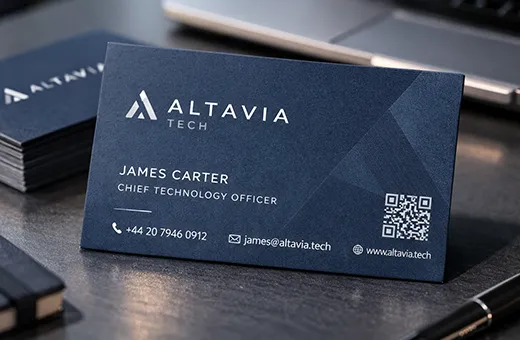
Paper cards are the substrate of choice for business cards, barcode loyalty cards, stamp loyalty cards and paper gift cards — all use cases where the card is either renewed frequently or distributed in much larger volumes than it is retained.
4. Side-by-side comparison (7 criteria)
4.1 durability and wallet lifespan
A standard PVC card at 0.76 mm comfortably handles 2 to 5 years of daily handling without fading, bending or breaking. Lamination further protects the print surface. Paper cards, even at 600 g/m² with premium finishing, typically last weeks to a few months at best in a wallet — the moment they fold or get wet, they are out of service.
4.2 perceived value and brand signalling
The weight, rigidity and edge feel of a PVC card communicate care and premium positioning before the customer even reads what is printed on it. For loyalty programmes targeting recurring customers, VIP recognition or member onboarding, that tactile signal does meaningful work. A paper card, however well-printed, signals a functional or temporary tool rather than a permanent relationship.
4.3 encoding options
PVC unlocks the full range of card encoding technologies: magnetic stripe (HiCo/LoCo), contact chip, contactless RFID and NFC. That is what makes it the only option for door access, hotel keys, public transport, payment systems and any reader-driven workflow. Paper cards are limited to optical encoding — barcodes (Code 128, EAN-13) and QR codes — which are excellent for POS scanning but cannot replace contactless or magnetic systems.
4.4 photo and variable data personalisation
Both materials accept variable data and photo personalisation. PVC delivers an edge-to-edge, high-resolution photo that remains sharp for years thanks to the protective lamination. Paper accepts photo printing too, but the paper texture shows through and the photo fades faster with handling. For employee IDs, student cards and member photos that need to stay readable for a full year or longer, PVC is the technically correct choice.
4.5 premium finishes
PVC supports a focused premium-finishing toolkit: hot foil stamping, spot UV varnish, signature panels and adhesive overlays — combined with gloss or matte lamination on every card to protect the print surface. Paper accepts hot foil stamping and embossing on premium stocks for similar visual impact, with spot UV available too. Our finishing options reference maps every available finish across both substrates.
4.6 unit cost
On a strict per-unit basis, paper is less expensive than PVC at comparable quantities. The cost gap narrows on small runs and widens on large volumes. However, comparing unit cost alone is misleading: a PVC card used by 1 customer for 3 years is often more cost-effective per usage than a paper card replaced every quarter. Get an itemised tailored quotation for an accurate side-by-side comparison.
4.7 production lead time
Paper cards are typically produced in 4 to 6 working days, while PVC cards take 6 to 10 working days as standard. Premium finishes on paper can extend lead time to 8 to 10 working days. Lead time confirmed on your quote. Full details on our delivery times reference page.
5. When to choose PVC cards
PVC is the right material when one or more of the following conditions apply to your card programme:
- The card has to last more than 12 months in daily use (loyalty, membership, employee ID, student ID).
- The card must interact with a reader (magnetic stripe, NFC, RFID, chip).
- You want the card to feel premium and signal a long-term relationship with the holder.
- The card carries a photo that needs to remain crisp after a year of pocket handling.
- You want access to premium finishes such as hot foil stamping, spot UV varnish or signature panels.
- You expect the card to survive water, sun, lanyard friction or repeated insertion into terminals.
In B2B card printing, that covers a very wide range of use cases — which is why PVC remains the default for most professional programmes, from retail loyalty schemes to bank member cards, hotel room keys and corporate employee IDs.
6. When to choose paper cards
Paper is the right material when one or more of the following conditions apply:
- The card has a short, defined lifespan (one campaign, one season, one event).
- You distribute very large volumes (event accreditations, mailings, in-store flyers with a barcode).
- You only need optical encoding (barcode or QR code), not contactless or magnetic.
- Your business is small and the volume does not justify a PVC investment yet.
- You want a low-tech loyalty mechanic (stamp cards in a bakery, café or salon).
- The card will be replaced frequently (paper visitor badges, contractor day passes).
- You want a faster lead time than PVC for a non-encoded run.
Paper cards excel in those scenarios precisely because their disadvantages on durability and perceived value do not matter: the card is not meant to last in the first place.
7. The hybrid approach: combining both
Many professional card programmes are not strictly one or the other — they use both substrates side by side for different parts of the same operation. Some patterns we see regularly:
- Retail loyalty programmes: PVC for regular customers (long-term relationship) + paper barcode cards for the long tail.
- Hospitality: PVC key cards for rooms (reader-driven) + paper gift vouchers for restaurants and spas.
- Events: PVC VIP and speaker passes (reusable, premium feel) + paper attendee badges (one-day disposable).
- Education: PVC student cards for one-year-plus enrolment + paper barcode cards for short courses and visitors.
- Corporate: PVC employee IDs (worn daily) + paper business cards (distributed at meetings).
Coordinating both substrates in a single project keeps branding consistent across the programme and reduces lead-time risk — our team regularly quotes mixed PVC + paper rollouts in one quote and one production schedule.
8. Pricing differences
On a like-for-like quantity, paper cards are roughly half the unit cost of PVC cards. That ratio narrows as soon as you add finishing (premium finishes have similar setup costs across both materials) and disappears entirely when you compare cost per usage instead of cost per unit.
Example: small retail loyalty programme (500 active customers)
Option A: 500 PVC loyalty cards used for 3 years → 1 production run at PVC unit price.
Option B: 500 paper loyalty cards used for 3 months, reprinted 12 times over 3 years → 12 production runs at paper unit price.
In real cases, the cost difference shrinks dramatically once you factor in the reprint cycles. PVC frequently wins on a 24-to-36-month horizon, while paper wins on a 0-to-6-month horizon. The break-even point depends on volume, finishing and replacement rate.
9. Sustainability and recyclability
Paper is more easily recyclable than PVC and biodegrades faster — that is the simple version of the story. The longer version is more nuanced. A PVC card that lasts 3 years before disposal can have a smaller cumulative environmental footprint than the equivalent paper card reprinted six times over the same period. Materials science and consumer behaviour interact in non-obvious ways.
On the PVC side, recyclable PVC stocks are now widely available, and biodegradable card substrates (corn-starch, PLA) are maturing as alternatives. We cover the full picture in our dedicated article on whether PVC cards are recyclable.
10. Frequently asked questions
Can paper cards be encoded with NFC or RFID?
In principle yes, by laminating a paper sheet around an embedded antenna — but the result is fragile and the cost approaches a standard PVC card. In practice, NFC and RFID encoding belongs on PVC. For contactless paper cards in volume, paper-PET hybrid composites are emerging but remain a niche.
Are paper cards more eco-friendly than PVC?
On a single-use basis, yes — paper is easier to recycle. On a multi-year basis with replacement cycles factored in, the comparison gets closer. The best environmental decision usually depends on the actual replacement rate of your programme, not the substrate alone.
Which material prints photos better?
PVC, by a significant margin. The smooth, even surface of a PVC card combined with edge-to-edge laminate protection produces a sharp, durable photo. Paper cards print photos cleanly but the texture remains visible and the photo fades faster with handling. For ID cards, employee badges and student cards, PVC is the technically correct choice.
Can i add foil and embossing to paper cards?
Yes. Hot foil stamping and embossing both work beautifully on premium paper stocks (350 to 600 g/m²). They are very popular for paper business cards and premium paper gift vouchers. Spot UV varnish is also available on paper, and signature panels can be added when relevant for the use case.
How long do paper cards last in a wallet?
A well-printed paper card on 600 g/m² stock with a protective varnish typically lasts a few weeks to a few months of regular wallet handling. Lighter stocks fold faster. For card programmes intended to last beyond one season, paper is rarely the right answer.
Can your team produce both materials in the same order?
Yes. We regularly produce mixed PVC + paper card programmes in a single quote and a single production schedule. This is especially common for retail loyalty schemes, hospitality groups, events and education programmes — see our industry pages for sector-specific examples.
Which material is faster to produce?
Paper, slightly. Standard paper cards are produced in 4 to 6 working days, vs 6 to 10 working days for standard PVC cards. Premium finishes on paper (foil, embossing) extend the paper lead time to 8 to 10 working days. Shorter lead times may be possible for both materials depending on the production schedule.
11. Final verdict
There is no universal winner between PVC and paper cards — there is a right material for each project. The decision tree is short:
- If the card needs to last, feel premium, or interact with a reader → PVC.
- If the card has a short lifespan, large volume and only optical encoding → paper.
- If your programme has both long-term and short-term cardholders → combine both.
For specific projects, the fastest way to a clear answer is to share your brief — quantity, intended use, encoding, rollout calendar — with our team. We will reply with an itemised quotation and the right material recommendation, typically within one business day.
Related articles
Talk to a custom card specialist
Still not sure which material fits your project?
Share your brief — quantity, intended use, encoding needs and rollout calendar — and we will reply with a clear, itemised quotation and a material recommendation aligned with your programme.