
Card technology · 10 min read
Magnetic stripe vs smart cards: differences that matter
Magnetic stripe and smart cards both encode data on a PVC body — but they belong to different generations of card technology, with sharply different implications for security, durability, cost and reader compatibility. This guide compares them across seven criteria so you can choose the right encoding for your B2B card programme.
1. Quick comparison at a glance
The 30-second answer across the seven criteria that matter most for a B2B card encoding decision:
| Criterion | Magnetic stripe | Smart card (chip / NFC / RFID) |
|---|---|---|
| Read mechanism | Physical swipe through reader | Insertion (contact chip) or tap (contactless) |
| Security level | Low to moderate (data easily copied) | Moderate to high (encryption, authentication) |
| Storage capacity | ~100 to 200 bytes (3 tracks combined) | 1 KB to 144 KB depending on chip |
| Durability | Stripe wears with repeated swiping | Antenna or chip lasts the card lifetime |
| Reader infrastructure | Widely deployed, legacy systems | Modern access, payment and transit systems |
| Unit cost | Lower | Higher (chip cost varies by family) |
| Best fit today | Hotel keys, gym day passes, library cards | Building access, transit, payment, secure ID |
Short version: magnetic stripe is the cost-effective workhorse of legacy reader systems. Smart cards are the modern standard for security, capacity and contactless workflows. Most new deployments lean smart; many established workflows stay magnetic for compatibility.
2. What a magnetic stripe card is
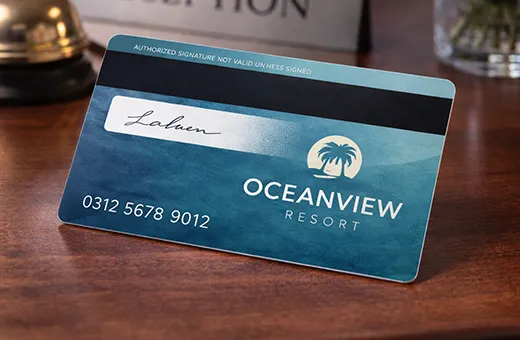
A magnetic stripe card is a PVC card carrying a band of ferromagnetic material on the back. Data is written onto the stripe by aligning the magnetic particles in specific patterns, and read by passing the card through a magnetic reader head that detects those patterns as the card is swiped.
The technology was invented by IBM in the late 1960s and has been the foundation of the global payment card system for decades. It still drives billions of transactions every year in hotels, transport, gyms, libraries and access control systems where reader infrastructure has not migrated to chips yet. Our dedicated magnetic stripe cards page covers the full range of available specifications.
The stripe carries up to three independent data tracks:
- Track 1 — 79 alphanumeric characters at 210 bpi. Used for cardholder names on bank cards.
- Track 2 — 40 numeric characters at 75 bpi. The most widely used track, encoding the primary card data.
- Track 3 — 107 numeric characters at 210 bpi. Rewritable. Used in some specialist applications.
Two coercivity standards exist:
- HiCo (high coercivity, 2750 or 4000 Oersted) — durable, resistant to accidental demagnetisation. The reference for hotel keys, transport cards and bank cards.
- LoCo (low coercivity, 300 Oe) — rewritable, cheaper, used for cards that need to be re-encoded (gym day passes, library cards, temporary access).
3. What a smart card is
A smart card is a PVC card embedding an integrated circuit (a chip) that can store and process data. Smart cards come in three main physical variants:
- Contact chip cards — a visible square chip on the front of the card, inserted into a reader for the contact. Bank cards and ID cards use this format.
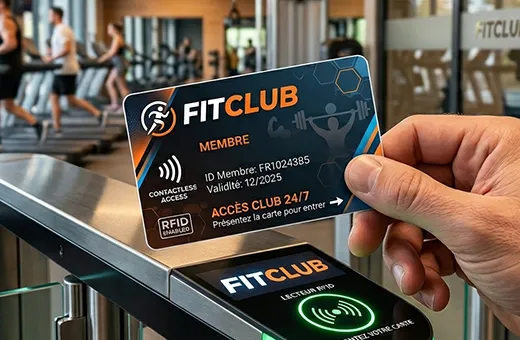
- Contactless cards — an antenna embedded inside the card body (invisible from the surface), reading at a few centimetres' distance. The dominant format today for transport, access and payment.
- Dual interface cards — both a contact chip and a contactless antenna on the same card, sharing one secure element. Used in modern bank cards and high-security ID.
The chip can be a simple memory chip (read-only data, basic identification) or a fully programmable microcontroller (encryption, mutual authentication, certificate storage, applet execution). The most widely deployed chip families in B2B card production today include:
- NXP Mifare (Classic / Plus / DESFire) — the dominant family for transport, corporate access and ticketing.
- NXP NTAG — NFC-friendly, smartphone-compatible, ideal for marketing and customer engagement.
- EM Marin 4xxx — 125 kHz legacy access standard, still common in installed door access systems.
- Java Card — programmable chip running Java applets, used for PKI, e-government and enterprise SSO.
See our article on what a smart card is for a deeper dive into chip families and their security characteristics, and our dedicated smart cards product page for the available specifications.
4. Side-by-side comparison (7 criteria)
4.1 security
This is the most important difference. Magnetic stripe data is unencrypted and trivially copyable with a standard reader — a major weakness for any application carrying valuable or sensitive data. Smart cards (especially DESFire EV2/EV3, modern contact chips and dual interface cards) implement mutual authentication, AES-128 encryption and tamper-resistant secure elements. For any new system protecting value or identity, smart cards are the technically correct choice.
4.2 storage capacity
Magnetic stripes store roughly 100 to 200 bytes of data — enough for an account number, a name, a few flags. Smart cards range from 1 KB on basic chips to 144 KB on high-capacity DESFire EV3 — enough to host multiple applications on the same card (transport, building access, cashless payment, loyalty).
4.3 read mechanism and user experience
Magnetic stripes require a physical swipe — slow, requires alignment, susceptible to dirt and wear. Contactless smart cards require a tap — fast, intuitive, no alignment, no wear from contact with the reader. The contactless user experience is one of the strongest drivers of smart card adoption in transport and retail.
4.4 durability
The magnetic stripe gradually demagnetises with repeated swiping (and with proximity to strong magnetic fields — phones with magnetic mounts, key fobs, anti-theft tags at stores). A typical magnetic stripe card delivers reliable reads for 6 to 18 months of intensive daily use before re-encoding or replacement. The chip and antenna inside a smart card, by contrast, last the mechanical lifetime of the card itself — 3 to 5 years on standard PVC, longer on composite stock.
4.5 reader infrastructure compatibility
Magnetic stripe readers are universal and inexpensive — installed in hotels, gyms, libraries, parking, vending machines, transport. Smart card readers are more recent, vary by chip family (Mifare reader ≠ EM Marin reader), and require integration with your specific access control or payment system. The encoding decision often comes down to which readers are already deployed in your environment.
4.6 unit cost
Magnetic stripe cards are the cheapest encoded card option — the cost premium over an unencoded PVC card is minimal. Smart cards carry a chip cost that varies by family — a few cents for a basic NTAG, more for a DESFire EV3 or a contact chip with PKI capability. For high-volume programmes, the unit cost gap narrows; for small runs, it can be significant.
4.7 multi-application support
A magnetic stripe carries one application (one set of data). A smart card — especially a DESFire or Java Card — can host multiple applications in independent sectors, all on the same card: building access in one sector, cashless payment in another, loyalty in a third. This is a fundamental architectural advantage in corporate, education and transport environments.
5. When to choose a magnetic stripe card
Magnetic stripe remains the right choice when one or more of the following conditions apply:
- The reader infrastructure is already magnetic (most hotel locks, legacy gym turnstiles, library terminals, parking systems).
- The data carried is low-value and non-sensitive (room number, day-pass token, library member ID).
- The card lifecycle is short (replaced or re-encoded every few weeks or months — gym day passes, hotel keys re-issued at every check-in).
- Unit cost is a tight constraint and the volume is high.
- The application does not need encryption, mutual authentication or multi-application support.
Hotel room keys are the textbook example — a magnetic stripe card with a HiCo encoding is the global standard for the major lock manufacturers (Salto, Assa Abloy, Vingcard, Onity, Dormakaba), and modern smart room cards have not yet displaced this installed base.
6. When to choose a smart card
Smart cards are the right choice when any of the following conditions apply:
- The data carried is sensitive or valuable (employee identity, payment credentials, secure access).
- The card needs to host multiple applications on the same physical card (corporate badge + cashless payment + loyalty).
- The user experience priority is fast, contactless reads at a turnstile, a POS or a smartphone.
- The card needs to last several years without encoding degradation.
- The reader infrastructure is already modern (NFC POS, RFID turnstiles, contactless transport gates).
- The system integrates with PKI or qualified electronic signature (Java Card with applet loading and certificate injection).
Corporate badges, transit cards, modern bank cards, e-government IDs, university campus cards and contactless event passes all fall into this category. The chip family is chosen to match the reader specifications — DESFire EV2/EV3 for modern secure access, NTAG for smartphone-friendly NFC, EM Marin for legacy 125 kHz door systems.
7. The hybrid approach (stripe + chip)
Many real-world card programmes use both technologies on the same card. The classic bank card is the most familiar example: a magnetic stripe on the back (for compatibility with older terminals and ATMs), and a contact chip plus contactless antenna on the front (for modern transactions). Both encodings carry consistent data and are programmed in sync at production.
For B2B card programmes, the hybrid approach is most common in two scenarios:
- Reader-migration projects — an organisation rolling out new smart card readers but keeping legacy magnetic readers active during the transition. The hybrid card works in both environments while the rollout completes.
- Multi-environment programmes — a corporate card that has to work at the office (modern smart reader) and at the gym across the street (legacy magnetic reader). The hybrid card supports both.
Hybrid cards add a moderate cost premium and require careful encoding coordination at production — both technologies must be tested before dispatch.
8. Migrating from magnetic stripe to smart cards
Most large-scale magnetic-to-smart migrations follow a phased approach. The card programme typically leads the reader infrastructure rather than the other way around — once the new card is in users' wallets, the operational pressure to roll out compatible readers becomes a stronger driver.
8.1 phase 1 — hybrid cards across the user base
Issue hybrid stripe + chip cards to all users at the next natural reissue point (annual renewal, new joiners, replacements). The existing magnetic readers stay functional; the chip stays unused for the moment. This phase typically takes 6 to 18 months depending on the renewal cycle.
8.2 phase 2 — reader rollout
Once the hybrid card penetration reaches 70 to 90% of the user base, the new smart readers can be deployed in parallel with the old magnetic readers. Both work; the smart reader becomes the default, the magnetic reader stays as a fallback.
8.3 phase 3 — sunset legacy
Once all users have hybrid cards and all sites have smart readers, the magnetic stripe can be deactivated and the reader fleet can be standardised on smart readers only. The next reissue cycle drops the magnetic stripe entirely.
The full migration typically runs over 2 to 4 years for a mid-sized organisation. Our team helps coordinate the card production schedule with the reader rollout schedule — see corporate card programmes and education card programmes for sector-specific patterns.
9. Sector-specific guidance
9.1 hospitality (hotels, resorts)
Magnetic stripe dominates room access today (Salto, Assa Abloy, Vingcard, Onity, Dormakaba). RFID smart cards are rising in premium properties and new builds, but the installed base remains magnetic. The right choice depends on your lock system — see our hospitality industry page.
9.2 corporate (offices, multi-site)
Smart cards (Mifare DESFire, EM Marin or HID Prox depending on the access control system) dominate corporate badges today. Magnetic stripe is rare in new corporate deployments. The chip family is dictated by the access control infrastructure — see corporate card programmes.
9.3 education (universities, schools)
University campus cards typically combine multiple applications: building access (smart card chip), library borrowing (barcode or chip), cafeteria payment (magnetic stripe in legacy systems, contactless in modern ones), printing services (chip or magnetic). Multi-application smart cards are increasingly the standard.
9.4 transport and public services
Modern transit systems are universally contactless smart cards (Mifare DESFire and equivalent). Magnetic stripe transit cards are legacy and being phased out in most major networks.
9.5 retail and loyalty
Retail loyalty programmes are typically barcode or QR code rather than magnetic stripe or chip — the encoding does not need to be magnetic or chip-based, just scannable at the POS. Magnetic stripe gift cards remain common for activation and balance management through the till.
10. Frequently asked questions
Are magnetic stripe cards being phased out?
Globally yes, but slowly. The installed reader base in hospitality, gyms, libraries and legacy access systems will keep magnetic stripe relevant for many years. Smart cards dominate new deployments, but magnetic stripe is not disappearing — it remains the cost-effective workhorse for low-value, short-cycle applications.
Can a magnetic stripe be re-encoded?
Yes, for LoCo magnetic stripes (300 Oe coercivity). LoCo is specifically designed for rewriting — gym day passes, library cards, temporary access. HiCo magnetic stripes (2750 or 4000 Oe) are typically permanent encoding for the lifetime of the card.
Can smart cards be cloned?
Modern secure smart cards (DESFire EV2/EV3, Java Card with proper key management, dual interface bank cards) are not practically cloneable — the secure element resists physical attacks and the cryptographic protocols prevent replay. Legacy chip families (Mifare Classic with Crypto-1) have known vulnerabilities and are no longer suitable for new secure deployments.
Which encoding is cheaper, magnetic stripe or smart card?
Magnetic stripe, typically by a clear margin. The chip cost on a smart card (especially Mifare DESFire or Java Card) is significantly higher than the magnetic stripe encoding cost. NTAG NFC chips are the most affordable smart card option and narrow the gap on high-volume programmes.
Can a card carry both a magnetic stripe and a chip?
Yes. Hybrid stripe + chip cards are common during reader-migration projects and on programmes that need to work across both modern and legacy reader environments. Bank cards are the most familiar example.
How long does a smart card last in daily use?
The chip and antenna inside a smart card last the mechanical lifetime of the PVC card body — 3 to 5 years on standard PVC, longer on composite stock. Smart cards do not degrade with use the way magnetic stripes do (the read is contactless or chip-based, with no mechanical wear on the data carrier).
What if my readers are mixed across sites?
A hybrid stripe + chip card is the standard solution for multi-site environments with mixed reader infrastructure. The card works everywhere; the user experience adapts to the reader at hand. Our team helps coordinate the encoding specifications to make sure both technologies are programmed consistently.
Can your team test the cards against my readers before dispatch?
Yes. Encoded batches are tested against reference readers before shipping. For projects with very specific reader models, we can replicate the reading environment if you share the reader model, or test against a working sample card you provide.
11. Final verdict
The decision tree is short:
- If the readers are magnetic and the data is non-sensitive → magnetic stripe.
- If the data is sensitive, the readers are modern, or the user experience priority is contactless → smart card.
- If you are mid-migration or working across mixed reader environments → hybrid stripe + chip.
For specific projects, the fastest path to a clear answer is to share your reader model, your access control system and your card volume with our team. We will recommend the right encoding combination, validate the parameters against your readers, and return a clear, itemised quotation — typically within one business day.
Related articles
Talk to a custom card specialist
Need the right encoding for your card programme?
Share your reader model, access system and card volume — we will reply with a clear quotation and an encoding recommendation validated against your specifications.