
Hi-Co & Lo-Co encoding
300 or 2750 Oersted coercivity on the same stripe range. The right specification chosen based on your reader type and reissue frequency.
Hi-Co / Lo-Co encoding · ISO 7811 tracks 1, 2 & 3
Professional magnetic stripe cards for hotels, parking, legacy POS, transport and access control still running on swipe infrastructure. Hi-Co or Lo-Co coercivity, full ISO 7811 track support, encoded and read-verified before dispatch.
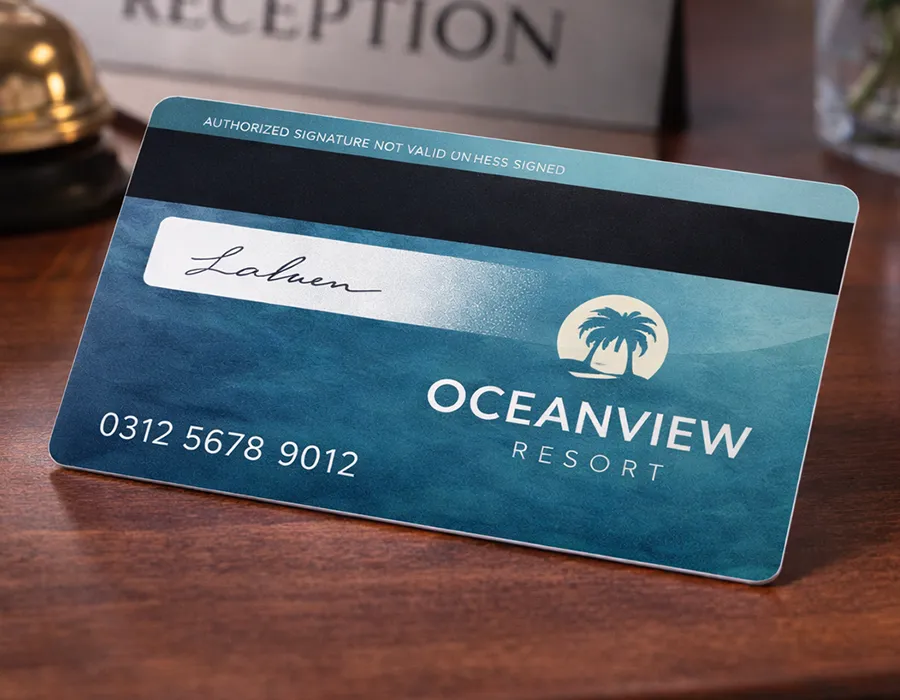
Why Lumacards for magnetic stripe cards
300 or 2750 Oersted coercivity on the same stripe range. The right specification chosen based on your reader type and reissue frequency.
Full ISO 7811 standard with tracks 1, 2 and 3 encoded independently or combined. Compatible with swipe readers across hotel, transport and retail systems.
Every stripe is written and then read-verified before the card leaves production. Cards are guaranteed readable on standard ISO 7811 equipment.
How it works
Magnetic encoding is unforgiving on the data side. A clear specification up front prevents reader-failure surprises on delivery.

Send your print-ready file with encoding spec and reader requirements — or brief us on the programme and our designers build the card.

A digital proof is sent by email for written approval before any production starts. Layout, encoding parameters (coercivity, track structure, data format) and visual rendering are locked upfront — production cannot launch without your sign-off.
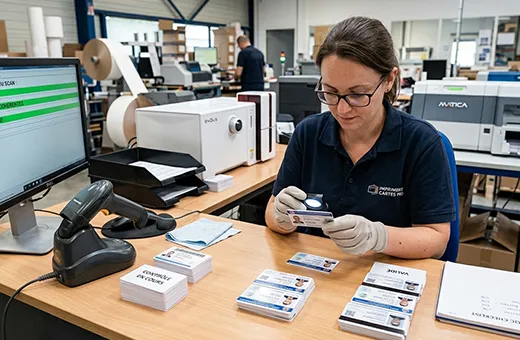
Every card is encoded, then read back and verified against the source file. Any card failing verification is automatically rejected and replaced before packing.
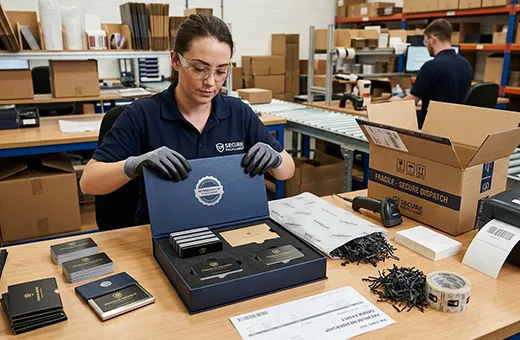
Cards are stacked stripe-to-back to prevent magnetic field interference during transit, then dispatched across Europe and the UK with tracked shipping.
Free quote — no commitment
Tell us about your reader type, encoding format and data structure — we return a tailored quotation within 24 hours. From 100 cards, lead time confirmed on your quote.
Get your quote in 24h
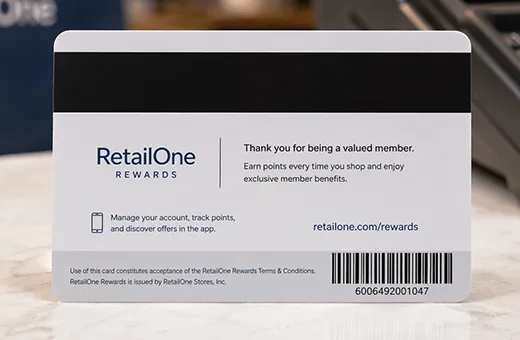
Standard banking and retail coercivity. Excellent durability for daily swipe use across retail POS, loyalty programmes and transport cards.
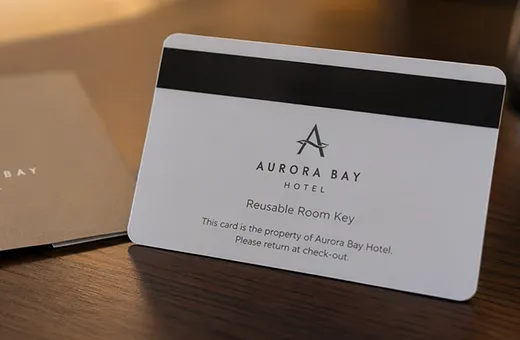
Lower coercivity designed for frequent re-encoding. Used for hotel room keys overwritten between stays, temporary access passes and internal badge reuse.
79 alphanumeric characters at 210 bits-per-inch, 7-bit encoding. Historically carries cardholder name and account identifier. Used when text data is required.
40 numeric characters at 75 bits-per-inch, 5-bit encoding. The most widely used track — primary account number, POS, ATM and most loyalty systems.
107 numeric characters at 210 bits-per-inch. Historically used for rewritable data — hotel systems, internal balances and transport networks.
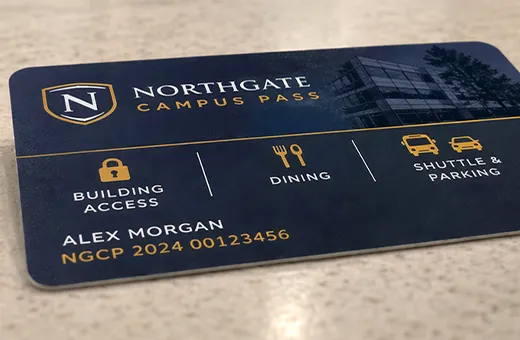
Tracks encoded in combination — 1+2, 2+3, or all three. Required when the card transits across multiple reader systems with different expected track layouts.
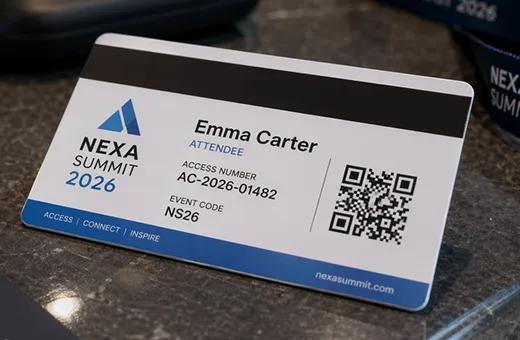
Printed personalisation on each card alongside the magnetic encoding — sequential numbering, barcode, QR code or variable text fields from your data file. Useful when the same card must carry a visible reference matching the data encoded on the stripe.
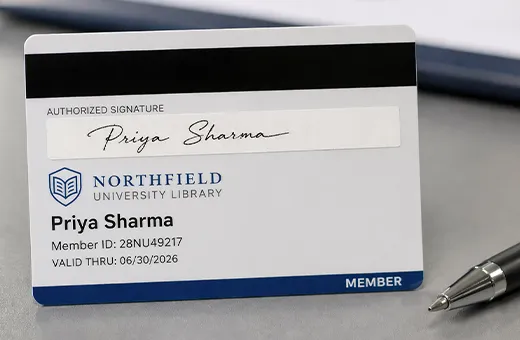
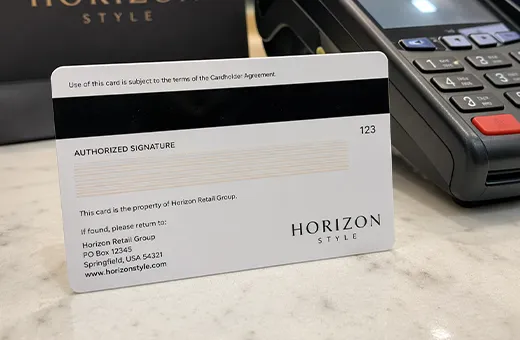
White writable panel placed above or below the stripe for cardholder signature — required when the card doubles as a member identification tool.
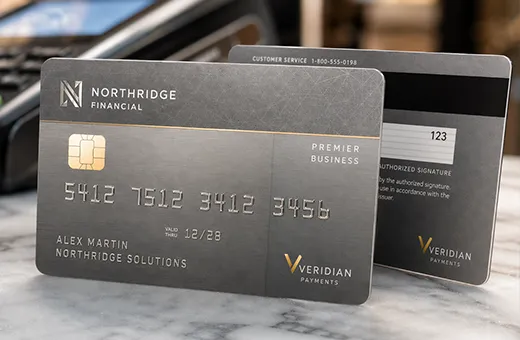
Magnetic stripe combined with a contact chip or contactless antenna on the same card. Essential during legacy-to-modern reader migrations.
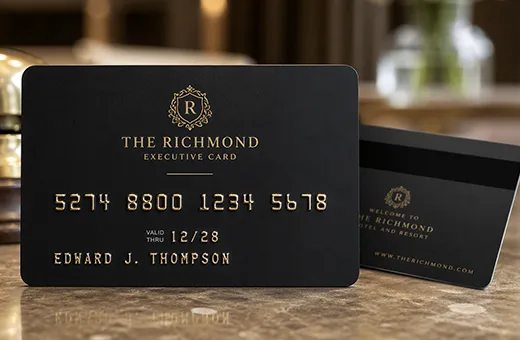
Raised cardholder name, number or unique reference pressed into the PVC — the classic bank-card style tactile personalisation. Available with variable data (one card, one raised number) for member, customer or access card programmes.
Frequently asked questions
Practical answers on coercivity, tracks, compatibility and data handling for technical buyers and system integrators.
Two questions decide it. First, how often is the card reissued or re-encoded? If the card is rewritten frequently (hotel keys between stays, short-term access passes), Lo-Co 300 Oe is the right choice. Second, how exposed is the card to strong magnets in daily use (phone cases, magnetic wallet closures, other cards in a stack)? If exposure is high and the card is kept for months or years, Hi-Co 2750 or 4000 Oe is safer. For most retail, banking, transport and long-term access use cases, Hi-Co is the default.
Track 2 is the answer in more than 80% of cases — POS, ATM, loyalty programmes, most retail swipe systems and legacy banking infrastructure all read track 2 as the primary data track. Track 1 is required when alphanumeric character data (cardholder name) must accompany the account number. Track 3 is used mostly by historical hotel, transport and internal balance systems. If you're unsure, share your reader documentation together with an existing working card: the track structure is confirmed against your specification before production.
Yes, when the encoding specification is known — this is one of the most common setup scenarios when a client wants to replace an existing batch. Send us the track structure, character format, start and end sentinels and coercivity (from your reader documentation or your previous card supplier), together with a working legacy card as reference sample, and we reproduce the same encoding on new cards. The specification must come from your side: undocumented or proprietary formats are not decoded. Useful for hotel chains, parking operators and transport networks replacing worn batches without reissuing the system configuration.
A CSV or Excel file with one row per card and one column per track works best. Each track field contains the full raw data for that track, including start and end sentinels if your reader expects them. Special characters such as field separators must be represented with their ISO 7811 equivalents. If your system documentation doesn't specify the exact format, ask your reader manufacturer or previous card supplier for the track specification: we build the data file from it and validate it on a small test batch before the full run.
Yes, and this is a common requirement during reader migration projects. We produce hybrid cards carrying a magnetic stripe on the back, a visible contact chip on the front, and optionally a contactless antenna inside the card body. The same card works on both the old magnetic swipe infrastructure and the new chip or contactless readers — useful for phased system upgrades where both generations of equipment must be supported.
Every single card is encoded and then read-verified against the source file before packing. Any card that fails read-back is automatically rejected and reprinted. The process is fully automated — it eliminates the risk of a batch arriving with undetected unreadable cards, which is the most common failure mode on magnetic stripe orders from lower-spec producers.
Cards are packed with a specific stacking method (stripe-to-back) that prevents magnetic field interference between neighbouring cards during transit. Avoid storing finished cards near strong magnets, magnetic clasps or bulk demagnetisers. Once in use, a Hi-Co card is generally unaffected by standard consumer magnetic sources (phones, handbag clasps, wallet covers). Lo-Co cards are more sensitive and should be handled with awareness of that.
Yes, in several specific contexts. Legacy POS systems, older hotel room-key infrastructure, regional transport networks and many internal access systems still run on magnetic stripe reading — replacing the hardware is often significantly more expensive than continuing to issue stripe cards. Magnetic stripe also remains useful as a fallback channel on hybrid cards, and as the encoding of choice where the card must be rewritten frequently (Lo-Co). For new deployments on modern infrastructure, smart cards are usually the better choice.
Yes. Two design routes alongside print-ready file orders. Template adaptation — share your hotel, transport or access programme identity, the encoding requirements and any back-of-card information (terms, instructions), and we adapt a magnetic stripe card template to your brand. Full custom design — our designers create the card from scratch with the magnetic stripe zone, signature panel and variable data positioning correctly handled. Both options are quoted alongside the print order.
Who uses magnetic stripe cards
Despite chip and contactless alternatives, magnetic stripe is still the daily workhorse across specific industry verticals.
Hotel room keys using Lo-Co for frequent re-encoding between guests. Spa, restaurant and resort access cards sharing the same stripe infrastructure.
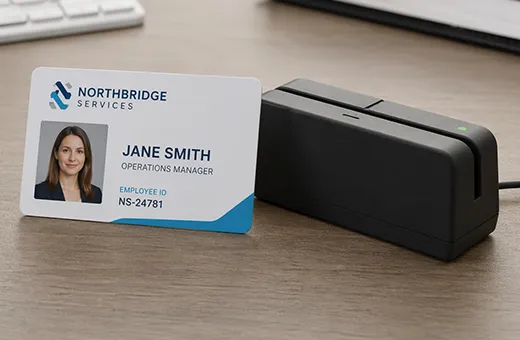
Parking entry and exit cards, staff access passes and vehicle permits for car parks, office buildings and logistics sites.
Retail chains and loyalty programmes running on long-established POS terminals where the stripe is the reliable reading channel.
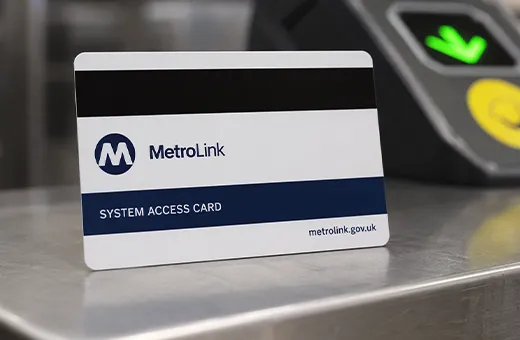
Regional transport networks, corporate canteens, internal balance systems and staff tracking — all frequently maintained on magnetic stripe.
Custom magnetic stripe card printing
A magnetic stripe card is defined first by the reader it must work with — not by the design printed on it. Every specification decision (coercivity, tracks, character format, start and end sentinels) is driven by the equipment on the receiving end. Lumacards produces magnetic stripe cards at ISO 7810 format (85.6 × 54 mm, 0.76 mm PVC) with full ISO 7811 encoding support: Hi-Co 2750 or 4000 Oersted for long-life and banking-grade use, Lo-Co 300 Oersted for rewritable applications such as hotel room keys. Tracks 1, 2 and 3 are encoded independently or in combination, with automatic read-verification of every card before packing.
Most magnetic stripe orders follow one of two scenarios. The first is replacing an existing worn batch while keeping the encoding identical — we work from the client's encoding specification and legacy card as reference, match the track structure and reproduce the same data format on new cards. The second is a new deployment where we help specify the right combination of coercivity, track layout and data format based on the reader model and expected usage frequency. In both cases the card can be combined with complementary technology on the same body: a contact chip for secure authentication, a contactless antenna for smart card migrations, or a printed photo and member number for membership and loyalty systems. Hybrid cards are particularly useful during phased infrastructure upgrades where both generations of reader must be supported during the migration window.
Get a tailored quote within 24 hours — from 100 cards, Hi-Co or Lo-Co encoding, read-verified before dispatch.