
PVC card basics · 10 min read
What are PVC cards? A complete introduction
PVC cards are the reference material for professional card programmes — loyalty schemes, gift cards, membership supports, ID badges, hotel keys, employee passes. This guide explains what they are made of, how they are produced, which formats and finishes are available, and how to choose the right specification for your project.
1. PVC cards in one paragraph
A PVC card is a rigid plastic card manufactured to the ISO 7810 ID-1 standard — the same physical specification as a bank or credit card (85.6 × 54 mm, typically 0.76 mm thick). The body of the card is made from polyvinyl chloride sheets fused together under heat and pressure, then printed in offset or digital and protected by a transparent laminated overlay. That construction is what makes PVC cards durable, wallet-friendly and compatible with the full range of encoding technologies — magnetic stripe, contact chip, contactless NFC and RFID. Most professional custom card programmes across retail, hospitality, education, banking and corporate use PVC as their default material.
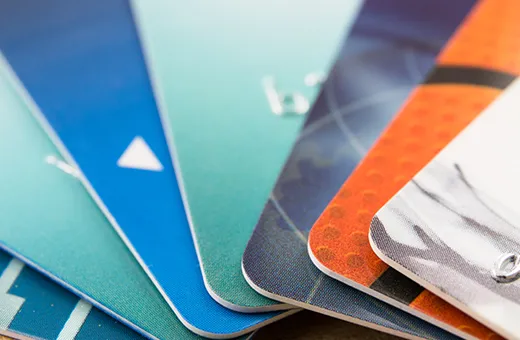
2. What PVC cards are made of
PVC stands for polyvinyl chloride, a thermoplastic polymer that combines rigidity, dimensional stability, resistance to handling and excellent printability. A finished PVC card is not a single sheet — it is a multi-layer composite built up like this:
- Top overlay — transparent laminate that protects the print surface from scratches and UV.
- Top print layer — white PVC sheet that carries the offset or digitally printed graphics (logo, photo, member data).
- Core layer — opaque PVC body that gives the card its weight, rigidity and thickness.
- Bottom print layer — second printed PVC sheet for the reverse side of the card.
- Bottom overlay — second transparent laminate, symmetrical with the top.
These layers are fused together under heat and pressure during lamination, producing a single rigid card. The exact stack varies depending on the project — additional layers can be added to embed a contactless antenna, an inductive chip, a magnetic stripe or a translucent decorative element. PVC composite cards (with a polyester core) offer higher resistance for intensive daily use.
3. How PVC cards are manufactured
Custom PVC card production follows a structured workflow built around the multi-layer composition described above. Our complete PVC card printing guide covers each step in detail; the simplified sequence is:
- Artwork preparation — print-ready files in CMYK with 3 mm bleed, fonts converted to outlines, finish zones isolated on dedicated layers.
- Digital proof — a free digital proof sent for written approval. Production cannot start without that sign-off.
- Sheet printing — offset or large-format digital printing of the top and bottom PVC sheets on the master format (typically 21 cards per sheet).
- Lamination — print sheets, overlay films, optional encoding layers (magnetic stripe, RFID antenna, chip) and the opaque core are stacked and fused under heat and pressure.
- Die-cutting — individual ISO 7810 ID-1 cards are punched out of the laminated master sheet.
- Personalisation & encoding — variable data (numbers, names, photos), magnetic stripe encoding, chip programming, all applied at this stage when relevant.
- Quality control — print quality, cutting precision, encoding readability, finish integrity inspected before packing.
- Packing & dispatch — cards packed in member-order sequence when required, then shipped across Europe and the UK.
Standard production lead time runs from 6 to 10 working days from proof approval (8 to 15 with chip, magnetic stripe or embossing). Shorter lead times may be possible on most standard configurations — see our delivery times reference for the full picture.
4. Standard dimensions and thickness
PVC cards are produced to the international standard ISO/IEC 7810, which defines four card sizes (ID-1, ID-2, ID-3, ID-000). The vast majority of B2B card programmes use the ID-1 format:
- Width: 85.60 mm
- Height: 53.98 mm (commonly rounded to 54 mm)
- Thickness: 0.76 mm reference, with available variants from 0.25 mm (thin) to 0.84 mm (composite)
- Corner radius: 3.18 mm (rounded corners)
The 0.76 mm thickness is the reference for wallet-compatible cards that need to interact with readers (cash machines, hotel locks, access turnstiles). Thinner stocks (0.30 to 0.50 mm) are common for promotional or short-term cards. The 0.25 mm translucent PVC stock is a popular choice for modern, design-led membership cards where a distinctive aesthetic matters more than maximum rigidity. For a specific project, the right thickness is confirmed alongside the encoding and finishing choices during the quotation.
5. Types of PVC cards by use case
"PVC card" is a generic name that covers many different products. Each use case carries its own set of conventions around encoding, finishing, photo personalisation and packaging:
- PVC loyalty cards — the most widely deployed B2B card. Barcode or QR per card, gloss or matte lamination, simple visual identity.
- PVC gift cards — magnetic stripe or barcode activation, often with hot foil stamping or spot UV for premium positioning.
- Membership cards — photo personalisation, member number, optional RFID or NFC encoding for access. Tier variations (Silver/Gold/VIP) common.
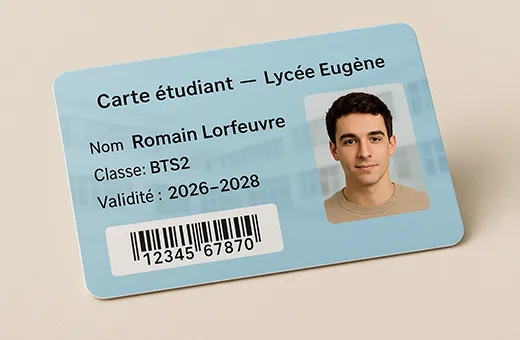
- Student cards — high-volume photo programmes aligned with the academic calendar. Barcode for library, magnetic stripe for cafeteria, chip for building access.
- PVC business cards — premium positioning for executives, with hot foil stamping or spot UV available.
- Magnetic stripe cards — HiCo and LoCo encoding for hotel keys, swipe access and legacy reader systems.
- Smart cards — contact chip, contactless NFC or RFID for secure authentication, transit, e-government and modern access control.
- Identification badges — employee, visitor and contractor badges with photo, role, category and validity dates.
6. PVC card encoding technologies
The strength of PVC as a material is that it can carry virtually any encoding technology available on the market. The right choice depends on what the card has to interact with — your readers, your POS, your access system. The most common encoding options are:
6.1 magnetic stripe
A magnetic stripe laminated onto the card carries up to three tracks of data. HiCo (high-coercivity, 2750 or 4000 Oe) is the durable, permanent-encoding option used for hotel keys, transport and banking. LoCo (300 Oe) is rewritable and suits cards that need to be re-encoded — gym day passes, library cards, temporary access. Magnetic stripe remains the workhorse of legacy reader infrastructure across hospitality and retail.
6.2 contact chip cards
A visible square chip embedded on the card surface, inserted into a reader for authentication. Memory chips (SLE4442, SLE5528) cover basic identification needs; Java Card and PKI chips support certificate injection for secure e-government, enterprise SSO and qualified electronic signatures.
6.3 contactless RFID and NFC
An antenna embedded inside the PVC body — invisible from the surface. The card is tapped against a reader at the gate, turnstile, POS or smartphone. Common chip families include Mifare Classic/Plus/DESFire (corporate and transit), NTAG (smartphone-compatible), EM Marin (125 kHz legacy access). Our article on what a smart card is goes deeper.
6.4 barcode and QR code
Printed optical codes — EAN-13, Code 128 or QR — scanned at the POS, the library terminal or the door reader. The simplest and most universally compatible encoding for loyalty programmes, library cards and member identification.
6.5 variable data and embossed numbering
Each card can carry its own unique data: member number, employee name, photo, validity dates, encoded value. On magnetic stripe cards, smart cards, membership cards and ID badges, embossed numbering is also available — raised cardholder name or number pressed into the PVC, the classic bank-card style tactile personalisation.
7. Available finishes on PVC
A PVC card body is the canvas — the finish layer is what gives it its perceived value. Lumacards offers a focused range of professional finishing options on PVC:
- Gloss or matte lamination — the standard protective layer applied on every card. Gloss for sharp colour rendering, matte for a more understated, professional look.
- Hot foil stamping — gold, silver, copper, rose-gold or coloured metallic foil applied with heat and pressure. The reference finish to lift perceived value on Gold, Platinum or VIP tiers.
- Spot UV varnish — glossy selective varnish on logo, text or graphic elements for refined visual contrast.
- Signature panel — white writable area on the back of the card where the holder signs for additional identity verification.
- Writable card + adhesive overlay — writable zone for member details filled in by hand, sealed with a transparent adhesive overlay. Used by associations and clubs personalising cards on the spot at enrolment.
- Translucent or transparent stocks — clear or semi-transparent PVC for boutique aesthetics, often combined with hot foil for striking visual impact.
Other premium finishes such as embossing on decorative logos, edge painting and soft-touch lamination are available on paper card programmes rather than on PVC. Our finishing options reference maps every available finish by substrate.
8. Common uses across B2B sectors
PVC cards are used in nearly every B2B sector, with sector-specific conventions:
- Retail — loyalty programmes, gift cards, VIP cards for chains, supermarkets and neighbourhood shops.
- Hospitality — magnetic stripe or RFID room keys, restaurant gift vouchers, hotel VIP cards.
- Education — student IDs with photo, faculty access cards, library cards.
- Banks & financial services — member cards, premium client cards, welcome packs with foil and signature panels.
- Corporate — employee IDs, NFC access cards, visitor and contractor badges.
- Events — multi-day PVC passes, VIP and press badges, exhibitor accreditations.
- Beauty & wellness — premium spa loyalty cards, beauty membership programmes, salon gift cards.
9. Lifespan and durability
A standard PVC card at 0.76 mm comfortably handles 2 to 5 years of daily wallet handling without fading, bending or breaking. The combination of the rigid PVC body and the protective laminate overlay is the key driver. For demanding daily use — gym turnstiles, multi-year memberships, lanyard-worn employee IDs — PVC composite stock (PVC with a polyester core) extends the lifespan further.
Factors that shorten PVC card lifespan in practice:
- Repeated bending (back-pocket carry, lanyard friction over hard edges).
- Extreme temperature variations (parked car in summer, freezer storage).
- Prolonged direct sunlight on the print surface (UV fading over multiple years).
- Chemical exposure (alcohol-based sanitisers used repeatedly on the same card).
For programmes that need to last more than a year, PVC remains the right material — paper alternatives typically degrade within weeks to a few months. See our PVC vs paper cards comparison for the full side-by-side.
10. PVC cards vs alternative materials
10.1 paper cards
The most common alternative. Paper cards work well for short-lived programmes (a season, a campaign, a single event), large-volume distributions and low-tech mechanics (stamp loyalty cards). They cannot match PVC on durability, encoding options or premium feel. Full comparison in our dedicated article.
10.2 polyester (PET) cards
Polyester offers higher heat resistance and dimensional stability than pure PVC. It is used as a core layer inside PVC composite cards for intensive daily use, and on transparent polyester cards (0.55 mm) for premium private members where a fully clear look matters. Pure polyester cards remain niche compared to PVC.
10.3 biodegradable and bio-based alternatives
Card substrates based on corn-starch, PLA or recycled PVC are now available for organisations with environmental priorities. Their print quality has improved significantly in recent years, although unit cost remains above standard PVC. Recyclable PVC stocks are another available route. See our article on PVC recyclability for the full picture.
11. Frequently asked questions
Are PVC cards the same as plastic cards?
Yes — "plastic card" is the colloquial term, "PVC card" is the technical one. The vast majority of plastic cards in circulation (loyalty, gift, member, ID, hotel keys) are PVC cards manufactured to the ISO 7810 ID-1 standard. A few specialist plastic card formats use polyester (PET) or polycarbonate (PC) instead, mainly for high-security ID documents.
Are PVC cards waterproof?
PVC cards are water-resistant rather than fully waterproof. The card body and the laminate overlay protect against splashes, rain, sweat and brief immersion without damage. Prolonged submersion or repeated chemical exposure (alcohol sanitisers, solvents) can affect the print surface over years.
Can a PVC card carry both a chip and a magnetic stripe?
Yes — these hybrid cards are common during reader-migration projects. The magnetic stripe sits on the back, the contact chip or contactless antenna sits on the front, and both are functional. Bank cards are the most familiar example.
How long do PVC cards last in daily use?
A standard 0.76 mm PVC card comfortably handles 2 to 5 years of wallet use without significant degradation. Composite PVC (PVC + polyester core) extends the lifespan further for intensive daily handling such as turnstile use or lanyard wear.
Can each PVC card have a unique number or photo?
Yes. Variable data printing — unique numbering, names, photos, barcodes, QR codes — is one of the most common requests for B2B card programmes. Provide a CSV or Excel file with one row per card and we produce cards with per-card variations.
Do PVC cards work with all reader types?
PVC cards can carry magnetic stripe, contact chip, contactless RFID/NFC and barcode/QR encoding — covering the vast majority of reader systems on the market. The encoding type is chosen to match your existing readers; we test the encoded batches against your reader specifications before dispatch.
Can PVC cards be recycled?
Standard PVC cards can be recycled through specialist plastic recycling channels — not in household paper bins. Recyclable PVC stocks are now widely available, and biodegradable substrates (PLA, corn-starch) are maturing as alternatives. See our dedicated article on PVC recyclability.
Can your team design the PVC card if we don't have artwork?
Yes. Two routes: template adaptation — share your brand identity and we adapt an existing card template; or full custom design — our in-house designers create the card from scratch including photo zones, finish areas and encoding visuals, with two rounds of revisions. Both routes are priced alongside the print order in a single quotation.
12. Next steps
PVC cards remain the reference material for almost every B2B card programme that needs to last more than a few months, feel premium in the holder's hand, and interact with a reader. The right specification — material thickness, encoding, finishing, personalisation — depends on the intended use and the brand positioning.
For a specific project, the fastest path to a clear answer is to share your brief — quantity, intended use, encoding, rollout calendar — with our team. We will reply with an itemised quotation and material recommendations, typically within one business day.
Related articles
- PVC Cards vs Paper Cards: Which to Choose?
- Custom PVC Card Printing: The Complete Guide
- Are PVC Cards Recyclable? Materials & Alternatives
- Magnetic Stripe vs Smart Cards: Differences That Matter
- What Is a Smart Card? Chip Cards Explained
- Variable Data Card Printing: From CSV to Card
- Secure Card Printing: Options to Prevent Counterfeiting
Talk to a custom card specialist
Need a PVC card programme, not just an article?
Share your brief — quantity, intended use, encoding needs and rollout calendar — and we will reply with a clear, itemised quotation and a material recommendation aligned with your programme.