
Use cases & programme design · 12 min read
How loyalty cards work: mechanics & best practices
A loyalty card is a tool that connects three things: a customer identity, a behaviour you want to reward, and a benefit you offer in return. The card itself is the physical bridge between the customer's wallet and your point-of-sale system. This guide covers the mechanics behind a working loyalty programme — earning logic, redemption flow, encoding choices, card design and the decisions that determine whether members stay engaged six months later.
1. Short answer: what a loyalty card does
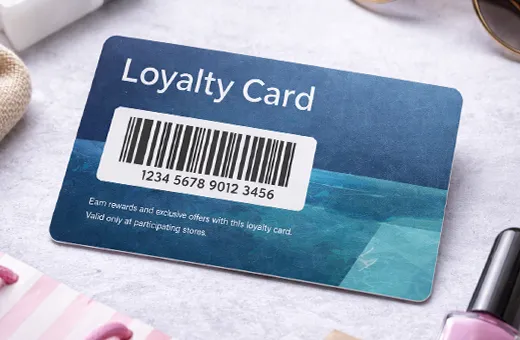
A loyalty card identifies a customer at the point of sale, records their purchase behaviour against a member profile, and unlocks a reward when a defined threshold is crossed. The card is the identity token — typically a PVC card or a paper card with a unique barcode, QR code, chip or stamped grid that the staff scans, taps or stamps at the till.
Without the card, the loyalty programme has no anchor. Apps can replace plastic, but plastic cards still dominate B2B loyalty deployments across retail, hospitality, beauty and proximity services across Europe — the card is universal, requires no smartphone, works offline, and stays in the customer's wallet between visits as a small permanent reminder of the brand.
2. The two purposes: identify + reward
A working loyalty card serves two functions that are technically distinct but operationally inseparable.
- Identification — the card carries a unique identifier (a member number, a barcode, a QR, a chip UID) that maps to a single member profile in your back-end system. The identifier is the bridge between the physical card and the digital record of that member's behaviour.
- Reward delivery — the card triggers an action at the till (points added, discount applied, free item issued, voucher generated) according to programme rules. The reward is the reason the customer carries the card; the identification is what makes the reward personalised and trackable.
A card programme that delivers a generic discount without identifying the member (a coupon, essentially) is not a loyalty programme — it is a discount card. A card programme that identifies the member but delivers nothing in return is not a loyalty programme either — it is a membership directory. The two functions have to be wired together to produce loyalty.
3. Earning mechanics (points, stamps, tiers, visits)
The earning mechanic is the rule that translates customer behaviour into accumulated value. Four dominant patterns cover most B2B programmes today.
3.1 points per spend
The most common pattern. Each €1 spent earns N points (typically 1 to 10 points per €). Points accumulate on the member's profile, the customer sees the balance on the till receipt or in the mobile app, and a reward unlocks when a threshold is crossed (e.g. 500 points = €5 voucher). The mechanic is universal: it applies equally well in retail, restaurants, hospitality and services.
3.2 stamps per visit
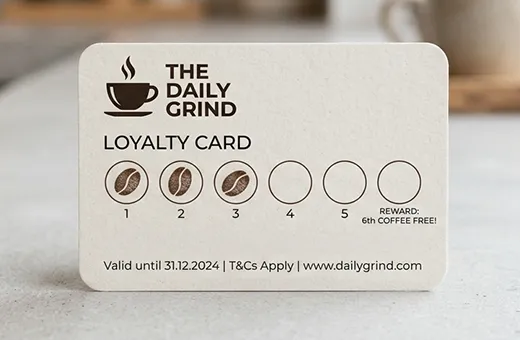
The simplest pattern, used heavily in proximity retail (coffee shops, bakeries, salons, food trucks). A paper stamp card carries a pre-printed grid (5, 8, 10 or 12 zones); each visit gets one physical ink stamp; the completed card unlocks a free item or a discount. No POS integration is required, no app — the stamp itself is the mechanic. Best for low-ticket, frequent-visit businesses.
3.3 tier-based membership
Members are placed into tiers (Classic / Silver / Gold / Platinum, or Bronze / Silver / Gold) based on annual spend, visits or membership duration. Each tier unlocks distinct benefits: free shipping at Silver, priority access at Gold, exclusive events at Platinum. The card itself often signals the tier visually (gold foil for Gold, distinct stock for Platinum). Tiered programmes drive customer aspiration — members spend more to reach the next tier. See our membership cards page for the dedicated product range.
3.4 recognition-based (subscription / unlimited access)
The card is not about accumulating — it is the credential. A gym membership card unlocks access to the facility. A museum patron card grants unlimited entry. A cinema unlimited card replaces tickets. The earning mechanic is the membership itself; the reward is continuous access. The card carries the active member identity and is validated on each visit.
4. Redemption mechanics (rewards in practice)
The redemption side of the equation is where the customer perceives value. Five forms of reward cover almost all programmes.
- Discounts at the till — a percentage off, a fixed amount off, applied automatically when the card is scanned. Universal, easy to understand, requires POS integration.
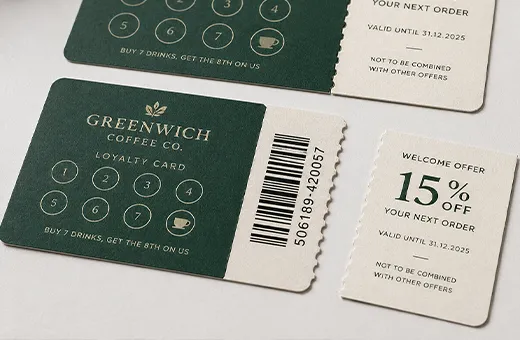
- Free items at threshold — the 10th coffee free, the 5th haircut free. Universal in proximity retail. Works with both stamp cards and barcode cards.
- Vouchers issued at threshold — accumulated points convert into a voucher printed at the till or emailed to the member. The voucher decouples earning from redemption (the customer comes back specifically to use it). See our gift cards page for the physical voucher products.
- Exclusive access or experiences — early access to new collections, members-only events, priority booking, free upgrades. Common in tier-based programmes and premium membership clubs.
- Personalised offers — the system tracks individual purchase patterns and sends tailored offers ("you usually buy X — here is 20% off X this week"). The most data-driven form of reward; the foundation is the unique identifier on the card.
The right reward form depends on what your customers value, your margin per transaction and how often they visit. A simple stamp-card "10th free" mechanic works brilliantly in a coffee shop where the customer visits weekly; it would be invisibly slow in a clothing store where the customer visits twice a year. Calibrate the reward cadence to the visit cadence.
5. Encoding choices and POS integration
The encoding on the card defines how the till reads the member identity. Four practical options for B2B loyalty programmes:
5.1 barcode (EAN-13 or code 128) — the workhorse
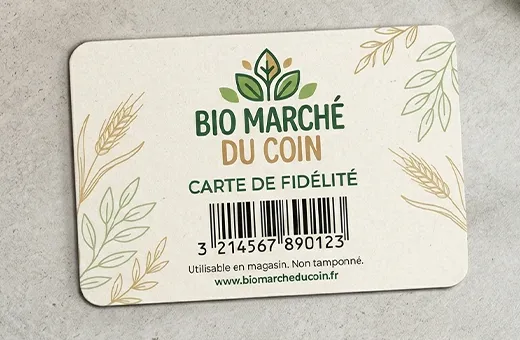
A unique 1D barcode printed on the back of the card, read by every laser scanner at every POS terminal. Universal compatibility, lowest unit cost, requires only that your POS software is wired to your loyalty platform. Used in the majority of retail loyalty programmes across Europe. See our companion guide: barcode cards for business.
5.2 QR code — smartphone-friendly
A unique 2D QR code on the card. Read by every smartphone camera and by modern 2D POS imagers. The QR can encode a member URL (opens a member portal in the browser), a token (validated server-side), or a plain member number. Increasingly common in omnichannel programmes where the card and the mobile app share one identity.
5.3 magnetic stripe — legacy POS
A magnetic stripe encoded with the member ID. Read by swipe terminals on older POS systems and on hospitality property management systems (Opera, Mews). The encoding can be HiCo (permanent) for member cards or LoCo (rewritable) for session-based programmes. See magnetic stripe cards for the full encoding range.
5.4 contactless chip (NFC / RFID) — premium and access-integrated
A contactless smart card chip (Mifare DESFire, NTAG NFC) that taps on a reader. Used on premium loyalty (gym memberships, private clubs, museum patron cards) and on programmes where the card doubles as an access credential (gym door + loyalty + cashless cafeteria on the same card). Higher unit cost but consolidates multiple uses on one card. See our companion guide: what is a smart card.
5.5 stamp (no electronics)
A paper card with a pre-printed grid; staff stamps a reward zone at each visit with an ink stamp. No POS integration, no app, no encoding — the physical card is the mechanic. The right choice for proximity retail without dedicated POS scanners. See our paper stamp loyalty cards product page.
Most programmes pick one encoding and stick with it; some hybrid programmes print both a barcode and a QR on the same card to cover laser POS scans and smartphone-led redemptions in parallel.
6. The card itself: design and material choices
Beyond the encoding, the physical card carries the brand and signals the programme's quality. The substrate, the finish and the design directly affect whether the customer keeps the card in their wallet or in a kitchen drawer.
6.1 PVC vs paper
PVC (0.76 mm, ISO ID-1) is the reference for multi-year wallet-resident loyalty cards: retail, hospitality, beauty, gym memberships. Durable, water-resistant, professional in-hand feel. Paper (300-400 gsm coated or uncoated) is the right choice for short-cycle programmes: seasonal campaigns, single-event member badges, stamp cards in proximity retail. For the full comparison see PVC vs paper cards.
6.2 finishes that signal value
Hot foil stamping, spot UV varnish, embossed numbering and signature panels all signal a higher-tier programme. Premium loyalty (private clubs, banking VIP, hotel platinum) typically uses one or more of these finishes; standard retail loyalty uses CMYK printing alone with lamination. The finish choice is a design decision that interacts directly with the perceived value of the programme — see finishes and customisation options.
6.3 design clarity
The card should communicate, at a glance, three things: which brand, which tier or membership, and where to scan / where the member number is. Cluttered cards with too many design elements lose this clarity. The strongest loyalty cards are visually disciplined — a logo, a tier indicator, a name and number, a barcode or QR — nothing more.
7. Variable data: one unique card per member
Each card carries unique data: the member name, the member number, the unique barcode or QR payload, the join date, optionally the tier, optionally a photo (for higher-trust programmes). The data file (typically a CSV exported from your CRM or loyalty platform) drives the print run — one row per member, one card per row, every card different.
Variable data is what makes loyalty traceable. A generic discount coupon hands the same offer to everyone; a member card with a unique identifier hands the offer to a specific person and records that the offer was used. The system can then identify who responds to which campaign, how often, at what value — the data foundation of any optimisation later. For the full production workflow see variable data card printing.
8. Programme design — what makes a loyalty programme last
Most loyalty programmes lose engagement within 6 to 12 months because the design phase under-invested in three areas: clear mechanics, achievable rewards and visible progress. The card supports the mechanic but does not create it.
8.1 mechanics that a customer can describe in one sentence
If a member cannot explain how to earn and how to redeem in a single sentence, the programme is too complicated. "Every 10€ spent = 1 point, 50 points = 5€ voucher." "10 coffees = 1 free." "Members get 10% off every visit." Simplicity drives use.
8.2 rewards that are achievable in a realistic visit horizon
A reward that takes 18 months of typical spending to unlock is invisible. Members forget the programme exists before they get there. Calibrate the threshold so an active member reaches the first reward within 6 to 12 weeks, with subsequent rewards at regular cadence afterwards.
8.3 visible progress at every interaction
The member should know — at every visit — how close they are to the next reward. Show the current point balance on the till receipt, in the mobile app, in periodic email statements. A loyalty programme where the customer cannot see their progress might as well not exist from the customer's perspective.
8.4 a wallet-friendly card the customer wants to carry
The physical card matters. A well-designed, durable, branded card in the wallet is a permanent visual reminder of the programme. A flimsy, generic, badly-printed card ends up in a drawer at home and the programme dies silently. This is where investment in the card itself returns directly to programme engagement.
9. Common pitfalls to avoid
- Reward unreachable in practice — a 500-point threshold for a customer who earns 5 points per visit will never reach the reward. Calibrate to actual spending patterns.
- Hidden balance — the customer cannot see their points balance. Print it on the till receipt or show it in the mobile app.
- No expiration clarity — members do not know if their points expire. State expiration policy on the card (or in the welcome material) — and choose policies that do not punish casual customers.
- Complex tier rules — moving between tiers should be deterministic and visible. "1 000€ annual spend = Gold" is clear; "100 points per quarter on top of activity multiplier..." is not.
- Card without a unique identifier — a generic discount card is not a loyalty card. Every card must carry unique data tied to a member profile.
- Programme launched without staff training — staff at the till are the front line of the programme. If they cannot explain or operate it, the customer does not adopt.
- Cheap card that looks disposable — a wallet card that looks like a coupon ends up in the bin. Investment in card quality returns to programme retention.
- Loyalty data not used — collecting member identifiers without analysing the resulting data wastes the foundation. The whole point of unique-per-card data is that you can learn from it.
10. Sector mini-guide
10.1 retail (fashion, beauty, food)
PVC card with unique barcode + tier-based or points-based mechanic + voucher rewards. Standard for chains, independents and local retail loyalty programmes. See our companion article loyalty cards for retail and the retail industry page.
10.2 hospitality (hotels, restaurants)
PVC card with magnetic stripe or contactless chip + tier-based mechanic + premium experiences as rewards (free nights, upgrades, late check-out). Often paired with the chain-wide member portal. See hospitality industry.
10.3 beauty and wellness
PVC card with QR or barcode + tier-based programme + free treatment after N visits. Often combined with personalised offers (birthday discount, anniversary gift). See beauty and wellness industry.
10.4 proximity retail (coffee, bakery, food truck)
Paper stamp card or paper barcode card + "Nth visit free" mechanic. No POS required, no app, no data infrastructure — the physical card is the entire programme. See our paper stamp loyalty cards and paper barcode loyalty cards ranges.
10.5 gyms and clubs (subscription-led)
PVC card with chip or QR for door access + recognition-based mechanic (membership = access) + premium tier upgrades. See our companion article on membership cards for gyms and clubs.
10.6 cultural institutions (museums, theatres)
PVC card with photo + chip or barcode + recognition-based mechanic (patron card = unlimited access) + exclusive previews and events as additional benefits.
11. Frequently asked questions
Are physical loyalty cards still relevant in 2026?
Yes. Apps have grown in share but plastic cards remain dominant across European B2B loyalty. They work for every customer (no smartphone required), work offline, sit permanently in the wallet as a brand reminder, and do not depend on app downloads or operating system updates. Most programmes use both — a card for universal coverage, an app for digital engagement.
PVC or paper for a loyalty card?
PVC for multi-year wallet-resident cards (retail, hospitality, beauty, gym). Paper for short-cycle or proximity retail (coffee shops, bakeries, single-season campaigns). The substrate decision is driven by lifecycle and perceived value — not by the encoding technology, which works on both. See PVC vs paper cards.
Which encoding should i use — barcode, QR, magnetic stripe, chip?
Barcode for universal POS compatibility (the default). QR if the customer journey involves a smartphone (mobile app, web portal). Magnetic stripe for legacy POS infrastructure. Smart card chip if the card doubles as an access credential or if security matters. The reader infrastructure already deployed in your environment usually dictates the choice.
How many cards do i need to order at launch?
Minimum 100 cards per project. For a launch, typical volumes range from a few hundred (small independent retail) to several thousand (regional chain rollout). Plan for natural attrition (replacement cards) and growth over the first 12 months when sizing the initial run.
Can the same card carry multiple uses (loyalty + access + payment)?
Yes — multi-application cards are common in education and hospitality. A student ID with library access (barcode), campus building access (chip) and cafeteria payment (magnetic stripe) is a single card with three independent encoded uses. The chip-based smart card families (Mifare DESFire, Java Card) support multi-application natively.
Should the card show the member's name or photo?
For high-value programmes (premium tiers, gym memberships, club cards) — yes. Personalisation creates ownership and prevents casual card-sharing. For low-ticket retail loyalty (coffee shop, supermarket) — usually no. The administrative overhead of per-member photo printing outweighs the protection benefit at low transaction value.
How fast can a loyalty card project be produced?
Standard production: 6 to 10 working days for PVC, 4 to 6 working days for paper, from artwork and CSV sign-off (8 to 10 for PVC with variable data). Shorter lead times may be possible on eligible specifications. See our delivery times page for the canonical schedule by product family.
Can the card design include a partner brand or co-branding?
Yes — co-branded loyalty cards are common (a retailer card co-branded with a bank, a hotel card co-branded with an airline). The artwork includes both brand logos and the encoding maps to the issuing system. The technical specification is identical to a single-brand programme; only the design coordination is different.
12. Next steps
The decision path for a loyalty card programme is short:
- Define the earning mechanic in one sentence (points per spend, stamps per visit, tier-based, recognition).
- Define the redemption form (discount, free item, voucher, exclusive access, personalised offer).
- Pick the encoding that matches your POS infrastructure (barcode, QR, magnetic stripe, chip, stamp).
- Pick the substrate that matches the programme lifecycle (PVC for multi-year, paper for short-cycle).
- Prepare the variable data file (CSV with member records) for the print run.
- Share the spec with our team for a tailored quotation — typically returned within one business day.
Related articles
- Loyalty Cards for Retail: Programme Design Guide
- Gift Cards for Stores: A Revenue-Driving Programme
- Membership Cards for Gyms & Clubs
- Barcode Cards for Business: A Practical Guide
- Variable Data Card Printing: From CSV to Card
- PVC Cards vs Paper Cards: Which Material to Choose?
- What Is a Smart Card? Chip Cards Explained
Talk to a custom card specialist
Ready to launch a loyalty programme that lasts?
Share your earning mechanic, your customer base and your POS environment — we will return a tailored quotation with the right encoding, substrate and finishing combination, calibrated to your programme design and your launch volume.