
Use cases & programme design · 12 min read
Loyalty cards for retail: programme design guide
Retail is the natural home of the loyalty card — fashion chains, supermarkets, beauty stores, bookshops, food retailers, neighbourhood boutiques. The card lives in customers' wallets between visits, signals the brand at every checkout and connects every purchase back to the member profile. This guide covers material choices, encoding decisions, card design, variable data, rollout strategy and the decisions that separate a retail loyalty card customers actually carry from one that ends up in a kitchen drawer.
1. Short answer: what works in retail today
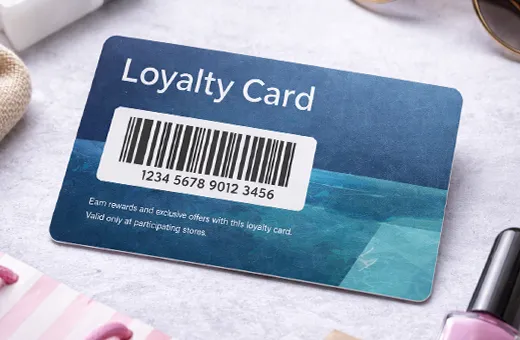
For most retail loyalty programmes across Europe, the working combination is a PVC card in ISO ID-1 format (85.6 × 54 mm, 0.76 mm thick) carrying a unique barcode (EAN-13 or Code 128) read by the existing POS scanner. The card prints the brand and the member number; the barcode is the bridge to the loyalty database; the membership tier — if any — is signalled visually (foil for VIP tiers, distinct stock for Platinum). Variable data prints one unique card per member from a CSV exported from the loyalty platform.
Around that workhorse pattern, four levers move the programme up-market: premium finishes (hot foil, spot UV) for tier-based programmes, QR codes alongside the barcode for mobile redemption, bio-PVC stock for sustainability-positioned brands, and detachable perforated coupons for promotional campaigns layered on top of the persistent loyalty card.
2. Retail loyalty fundamentals
Three earning mechanics dominate retail loyalty deployments today, and the choice has direct implications on the card design and the encoding.
2.1 points-per-spend (the workhorse)
Every euro spent earns N points; points accumulate; a threshold unlocks a reward. The most universal mechanic in retail — fashion, supermarkets, beauty, books, electronics. The card carries the brand and the member number; the points balance lives in the back-end system; the reward is delivered at the till or via voucher. See our companion article on how loyalty cards work for the broader mechanic comparison.
2.2 tier-based programmes
Members are placed into tiers (Classic / Silver / Gold / Platinum, or Bronze / Silver / Gold) based on annual spend or cumulative loyalty value. Each tier unlocks distinct benefits — early access to collections, free shipping, exclusive events. The card itself signals the tier visually: a metallic foil colour, a distinct stock for the top tier, a tier name printed on the front. See our membership cards page for the dedicated tier-card range.
2.3 hybrid: persistent card + detachable coupons
A growing pattern in retail: the persistent loyalty card carries the member identity, and a strip of perforated coupons attached to the card carries time-limited offers (welcome discount, monthly promo, seasonal voucher). The customer tears off the coupon at the till for one-time redemption; the persistent card stays in the wallet for ongoing tracking. The two mechanics coexist on the same physical card.
2.4 stamp-led (proximity retail)
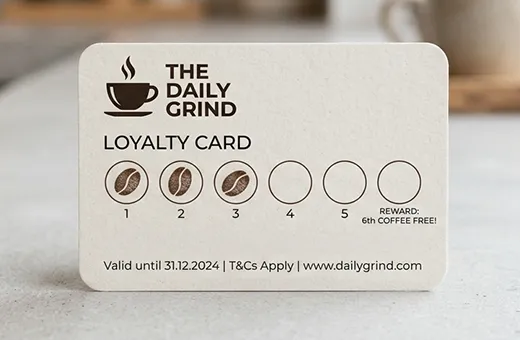
For proximity retail without a POS scanner — coffee shops, bakeries, small specialty stores — a printed stamp loyalty card is the right mechanic. No encoding, no database, no app — the staff stamps a reward zone at each visit, the card unlocks a free item when the grid is full. The simplest retail loyalty mechanism still in active use across Europe.
3. Material choice — PVC, bio-PVC or paper
3.1 standard PVC 0.76 mm — the retail reference
The dominant substrate for retail loyalty cards across Europe. ISO 7810 ID-1 format, wallet-friendly thickness, excellent print quality, durable across years of daily handling. The right choice for any retail programme expected to last more than 12 months on the same physical card. See PVC loyalty cards.
3.2 Bio-PVC — the eco upgrade for retail brands
For retail brands with a sustainability story to tell — natural beauty, organic grocery, fashion with eco-positioning — bio-PVC is the practical upgrade. The polymer chemistry is identical to standard PVC (same printability, same durability, same barcode and QR readability at the POS), but a portion of the raw material is sourced from renewable biomass (sugarcane-derived bio-ethanol) instead of fossil hydrocarbons. The carbon footprint at production is significantly reduced; the in-wallet experience is indistinguishable from standard PVC. The natural pairing with the brand sustainability narrative for retailers that already invest in eco-positioning elsewhere. See our companion article are PVC cards recyclable for the broader materials comparison.
3.3 paper barcode loyalty cards — cost-efficient and recyclable
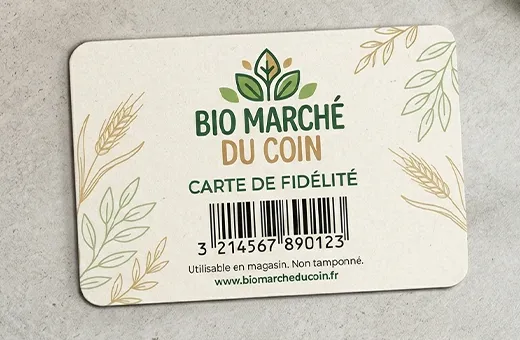
For short-cycle programmes (one season, one campaign, one promotional push) or for retailers positioning the card as a consumable rather than a wallet-resident credential, a paper barcode loyalty card on coated or recycled stock is the right substrate. Lower unit cost than PVC, fully POS-scannable (the barcode works identically), and naturally biodegradable at end-of-life. Common in seasonal retail campaigns and in beauty / food retail programmes targeting a younger eco-conscious audience.
3.4 paper stamp loyalty cards — proximity retail without POS
For proximity retail without a dedicated POS scanner — coffee shops, bakeries, food trucks, hairdressers, small specialty stores — a paper stamp loyalty card remains the simplest, fastest and most resilient mechanic. The card prints a grid of 5, 8, 10 or 12 reward zones; the staff stamps one zone at each visit with a custom-shaped ink stamp; the full grid unlocks a free item or a discount. No POS integration, no database, no app, no digital infrastructure — the printed card is the entire programme.
The substrate matters: stamp cards are printed on uncoated paper selected for clean ink absorption, so the staff's existing stamp ink dries quickly without smudging on the laminated surface that would defeat the mechanic. Common stocks include uncoated 300-400 gsm, FSC-certified recycled paper and natural kraft. Custom stamp shapes (coffee cup, croissant, flower, brand logo) are part of the design and reinforce the proximity-retail brand identity. The unit cost is the lowest of all retail loyalty card options.
3.5 choosing the right substrate
A simple decision rule covers most cases:
- PVC — multi-year card kept in the wallet across many visits. The default for chain retail and member loyalty.
- Bio-PVC — same use case as PVC, plus a sustainability brand story. Eco beauty, organic food, fashion with green positioning.
- Paper barcode — short-cycle campaign, lower unit cost, recyclable. Seasonal promotion, single campaign rollout.
- Paper stamp — proximity retail without POS scanner. Coffee, bakery, food truck, small specialty.
4. Encoding choice — POS-driven
The encoding decision in retail is dictated by what your point-of-sale system reads. The card has to match the scanner already on the counter, not the other way around.
4.1 EAN-13 barcode — the retail standard
Every retail POS scanner across Europe reads EAN-13 — it is the standard for product barcodes on every consumer item, so the infrastructure is universal. A unique 13-digit EAN-13 on the back of the loyalty card scans natively at the till, the POS software routes the payload to the loyalty platform, and the points are added or the reward is applied. The default encoding for any retailer with a standard POS environment.
4.2 code 128 — for alphanumeric member IDs
When the member ID combines letters and numbers (a brand prefix, a regional code, an alphanumeric sequence), Code 128 is the right barcode standard. Same scanner compatibility as EAN-13, variable length, full ASCII support. Used by retailers whose loyalty platform issues alphanumeric identifiers. See our companion guide on barcode cards for business.
4.3 QR code — for mobile-led redemption
A unique QR per card in addition to (or instead of) the barcode. Scanned by the customer's smartphone, the QR opens the member portal, a redemption landing page or a deep link into the retailer's mobile app. Increasingly common in omnichannel programmes where the same identifier resolves the customer at the till and in the app. Print both EAN-13 and QR side by side on the back of the card for hybrid coverage.
4.4 magnetic stripe — for legacy POS
Some hospitality-adjacent retail (premium department stores, certain hospitality concept stores) still operate POS systems that read magnetic stripe. A HiCo (2750 Oersted) encoded stripe on the back of the card carries the member ID for swipe-based identification. See our magnetic stripe cards range and the comparison magnetic stripe vs smart cards.
4.5 NFC / smart card — for premium retail
A contactless smart card chip (Mifare DESFire, NTAG) is rare on mass retail loyalty but common on premium and luxury retailers where the card doubles as an access credential to client lounges, private events or store appointments. The chip carries the member identity with cryptographic protection — relevant when the loyalty card is also the access card to value (private viewing rooms, member-only floors).
5. Card design and brand expression
A retail loyalty card competes with seven other cards in the customer's wallet. The design has to earn its place — visually, tactilely, structurally. Three design dimensions drive that competition.
5.1 brand expression at the front
The logo, the colour palette, the tier indicator. A retail loyalty card front should communicate, at a glance, three things: which brand, which tier (if any), and that this is a loyalty / member card (not a gift card, not a discount coupon). Clutter is the enemy — the strongest retail cards are visually disciplined.
5.2 finishing for tier signalling
Premium tiers in retail loyalty (VIP, Platinum, Black) typically use:
- Hot foil stamping — gold, silver, copper or rose-gold foil on the brand mark or the tier name. The most recognised premium signal across retail and hospitality. See our finishes and customisation options.
- Spot UV varnish — clear gloss varnish on selected areas creates a tactile reflective layer on an otherwise matte card. Used on premium ranges for a more discreet signal than foil.
- Distinct substrate for top tier — frosted PVC, transparent PVC or a black-core PVC for the highest membership level. The substrate itself becomes part of the tier identity.
5.3 functional layout on the back
The back of the card carries the barcode, the member number printed under the barcode, the brand programme name, the customer service URL, optionally the issue date. Keep this side clean: the barcode needs a clear quiet zone around it (10× the X-dimension of the narrowest bar) and a high-contrast white background under the bars. Coloured backgrounds or graphics under the barcode are the most common production error on retail loyalty cards.
5.4 detachable coupon zone (when relevant)
For retail programmes mixing persistent loyalty with time-limited promotions, a perforated detachable coupon attached to the loyalty card carries the promo offer separately. The customer tears off the coupon at the till; the loyalty card stays in the wallet for ongoing tracking. The perforation line, the coupon graphics and the redemption mechanism (printed code, separate barcode) all live in a clearly delineated zone of the card.
6. Variable data — unique member per card
Every retail loyalty card carries unique data tied to a single member. The data file (typically a CSV exported from the loyalty platform) drives the print run — one row per member, one card per row, every card unique. The variables include:
- Member number — the persistent identifier, printed on the front (visible reference) and encoded into the barcode (machine-readable).
- Member name — typically printed on the front for personalised tier cards and premium programmes; often omitted on mass retail cards for production speed.
- Unique EAN-13 or Code 128 barcode — the scanner-readable identifier. Each card carries a different barcode payload pulled from the data file.
- Unique QR code — when the programme is mobile-led, each card has its own QR resolving to a unique landing page or token.
- Tier indicator — for tier-based programmes, the tier name (Classic / Gold / Platinum) printed or signalled through the card finishing.
- Issue date or validity — optional. Used for time-bound campaigns or for renewal-cycle programmes.
The CSV from the loyalty platform should be cleaned and validated before printing — unique IDs, consistent casing, normalised fields, barcode checksums verified for EAN-13. For the full data preparation workflow see variable data card printing.
7. Rollout strategy — chains vs independents
The rollout approach for a retail loyalty card depends heavily on whether the deployment is centralised (a chain with one HQ decision) or distributed (an independent retailer or a small group of franchise stores).
7.1 single-store launch (independent retail)
Typical volume: 200 to 1 000 cards for an initial launch. The data file comes from the existing customer database (POS export or CRM extract). Production runs in one batch; the cards are delivered to the store and handed out at the till on the next visit. The simplest retail loyalty deployment pattern — limited operational complexity, fast turnaround. A shorter lead time may be possible at this scale.
7.2 multi-store chain rollout
Typical volume: 5 000 to 50 000+ cards across 10 to 200 stores. The rollout typically follows a two-step pattern:
- Phase 1 — central launch — initial card batch produced and delivered centrally, then distributed across stores. New members are enrolled at each store on first visit, and cards are typically produced in advance with sequential member numbers, distributed empty for issuance.
- Phase 2 — replenishment — monthly or quarterly replenishment runs based on actual enrolment volumes. The data file is refreshed from the central loyalty platform; new card batches are produced and shipped to stores as the previous stock runs low.
For very large chain rollouts (national or pan-European), the rollout is often staged geographically — region by region — to spread the operational load and to test the programme mechanics before the full deployment.
7.3 welcome packs vs counter handout
Two distribution patterns dominate retail loyalty: welcome pack (the card is delivered in branded packaging with a welcome leaflet, often given to new members who fill in a registration form) and counter handout (the card is handed bare from a tray at the till with a brief verbal explanation). Welcome packs build perceived value at higher unit cost; counter handouts maximise enrolment speed at the cost of perceived programme value. The right pattern depends on the retail format and the average basket size.
8. Co-branded and partner programmes
Retail loyalty increasingly extends beyond the single-brand programme. Two co-branded patterns are common today.
8.1 retailer + bank co-branded cards
The card serves both as a loyalty identifier (retailer's loyalty programme) and as a payment instrument (bank-issued credit or debit). The chip handles payment; the printed brand and barcode handle the loyalty side. Production and encoding are coordinated between the retailer's loyalty platform and the bank's card-issuing operation. See our banking card programmes page.
8.2 retail group cross-brand cards
A retail group running multiple brands (fashion + beauty + home, for example) issues a unified loyalty card valid across the portfolio. The card carries the group identity; the back lists the participating brands; the same member number works across every store. Common pattern in retail conglomerates and shopping centre loyalty programmes.
8.3 multi-store local partnerships
Smaller-scale: a group of neighbouring independent retailers (typically 5 to 15 shops in a town centre or shopping district) run a shared loyalty card. The card is recognised across the participating stores; the back lists the partners; redemption happens at each member store independently or through a shared platform. A growing pattern in proximity retail and high-street revitalisation programmes.
9. Retail sub-sectors — what works where
9.1 fashion and apparel
Tier-based programmes are dominant — Silver / Gold / Platinum with escalating benefits (early access to collections, exclusive events, free alterations). Premium finishes (hot foil, spot UV) are standard on top tiers. PVC is the default substrate; bio-PVC for brands with eco-positioning.
9.2 grocery and supermarkets
Points-per-spend with periodic voucher rewards. High volume, fast checkout — the card has to scan reliably and quickly under retail lights. EAN-13 barcode on standard PVC is the universal pattern. Tier programmes are uncommon (supermarket loyalty is usually flat).
9.3 beauty and cosmetics
Often tier-based with frequent personalised offers (birthday gift, sample with purchase). Premium finishes are part of the brand story — hot foil and embossed cards are common. Bio-PVC pairs naturally with the clean beauty / natural beauty positioning. See our beauty and wellness industry page.
9.4 bookshops and specialty retail
Points-per-spend with discount vouchers. Lower transaction volume per member than supermarkets — the card design typically leans toward a craft / editorial visual identity. PVC standard or paper barcode for cost-conscious independent bookshops.
9.5 food retail and proximity (coffee shops, bakeries, food trucks)
Stamp loyalty card on paper is the dominant pattern. No POS integration, no database — the stamp itself drives the mechanic. For shops with a POS scanner and a small loyalty platform, paper barcode cards on coated stock are the next step up. See our paper stamp loyalty cards and paper barcode loyalty cards ranges.
9.6 department stores and large-format retail
Tier-based with multi-brand redemption across departments. Often a co-branded credit card option for the top tier. Magnetic stripe (legacy POS in older stores) or barcode + NFC chip (modern POS). The card design typically reflects the institutional brand identity rather than a single product line.
10. Common pitfalls to avoid
- Barcode contrast issues — gloss lamination over the barcode introduces reflective glare under POS lights. Specify matte lamination over the barcode area or leave the barcode panel unlaminated.
- Coloured background under the barcode — barcodes must be solid black on white. Brand colours under the bars degrade read rates.
- Cluttered front design — too many design elements compete for attention. The strongest retail loyalty cards have a clean brand front and a functional back.
- Tier indication too discreet — if the member cannot tell which tier they are at a glance, the tier mechanic loses its motivational power. Make the tier visible.
- Member number too small or too large — printed at a readable size for the staff at the till (some redemptions still happen by manual entry). 9 to 11 pt typeface is the sweet spot.
- Production volume under-sized for rollout — running out of cards mid-launch interrupts enrolment momentum. Plan for the actual enrolment curve, not just the initial estimate.
- No replenishment plan — chain rollouts that produce a single batch without a replenishment schedule run out at the worst moment. Schedule the second batch before the first one runs low.
- CSV from the loyalty platform not cleaned before printing — duplicate member IDs, missing names, malformed barcode payloads. Validate the data file before sending it to production. See variable data card printing.
- Card released without staff training — staff at the till are the front line of the programme. If they cannot explain the loyalty mechanic in one sentence, enrolment stalls.
- Sustainability claim without substrate to back it — claiming "eco-friendly" on a standard PVC card is misleading. If the brand positions on sustainability, the card substrate has to align — bio-PVC, recycled PVC or paper.
11. Frequently asked questions
What is the minimum order for a retail loyalty card programme?
100 cards minimum on PVC, 100 cards minimum on paper. For independent retail launches, the initial batch is typically 200 to 1 000 cards. For chain rollouts, volumes range from a few thousand cards to several hundred thousand depending on store count and enrolment expectations.
How long does a retail loyalty card project take to produce?
PVC loyalty cards: 6 to 10 working days standard production (8 to 10 with variable data). Paper loyalty cards: 4 to 6 working days standard. Shorter lead times may be possible depending on the production schedule, provided the variable data file and the artwork are clean and signed off on day one. See our delivery times page for the canonical schedule.
Which encoding should i choose if my POS reads barcodes already?
If your POS reads EAN-13 (which is the case for essentially every retail POS in Europe), pick EAN-13 as your loyalty card barcode. If your member IDs are alphanumeric, pick Code 128 — same scanner compatibility, supports letters and numbers. For mobile-led redemption add a QR code alongside the barcode. Do not pick magnetic stripe or chip unless your specific POS system requires it.
Should the card print the member's name?
For tier-based and premium programmes — yes. Personalisation reinforces the membership feeling and reduces casual card-sharing. For mass retail with high enrolment volumes — typically no. The administrative overhead and the production time of per-member name printing outweighs the personalisation benefit at low ticket value.
Can the card carry both a barcode and a QR code?
Yes, and it is increasingly common in retail. Print the EAN-13 (or Code 128) on the back for POS scanning and the QR alongside for mobile-led actions (member portal, redemption page, app deep link). Both encodings can resolve to the same member identifier server-side. Allow sufficient quiet zone around each.
Is bio-PVC more expensive than standard PVC?
Modestly. The cost premium of bio-PVC over standard virgin PVC has been narrowing each year as the supply chain matures. For most retail loyalty programmes, the premium is comparable to choosing a slightly more premium finish — a meaningful but absorbable cost difference. The premium is more pronounced on small runs and narrows on high-volume programmes.
Can i add detachable coupons to a loyalty card?
Yes. A perforated zone on the card carries one or several coupons that the customer tears off for time-limited redemption. The persistent loyalty card stays intact; the coupon detaches at the till. Common pattern for retailers mixing ongoing loyalty tracking with seasonal promotional pushes. The perforation line, the coupon design and the redemption mechanism are part of the production specification.
How do i handle card replacement for lost or damaged cards?
Most retail loyalty programmes maintain a small replacement stock at each store (typically 5 to 10% of the active member base) and request a new replenishment batch when the replacement stock falls below a threshold. The replacement card is issued at the next visit; the member number is either preserved (the new card replicates the old identity) or reissued (a new number is generated and the old one is invalidated). The replication-vs-reissue choice depends on the loyalty platform.
12. Next steps
The decision path for a retail loyalty card programme is short:
- Define the earning mechanic (points / tier / stamp / hybrid) and the redemption form.
- Pick the encoding that matches your POS (barcode for almost all retail; QR for mobile journeys; smart card for premium).
- Pick the substrate that matches the lifecycle and the brand positioning (PVC / bio-PVC / paper).
- Calibrate the finishes to the tier structure (premium foil / spot UV for top tiers; matte standard for the base tier).
- Prepare a clean CSV with one row per member from your loyalty platform.
- Plan the rollout (single batch for independents; phased rollout with replenishment for chains).
- Share the spec with our team for a tailored quotation — typically returned within one business day.
Related articles
- How Loyalty Cards Work: Mechanics & Best Practices
- Gift Cards for Stores: A Revenue-Driving Programme
- Membership Cards for Gyms & Clubs
- Barcode Cards for Business: A Practical Guide
- Variable Data Card Printing: From CSV to Card
- Are PVC Cards Recyclable? Materials & Alternatives
- PVC Cards vs Paper Cards: Which Material to Choose?
Talk to a custom card specialist
Ready to launch a retail loyalty card programme?
Share your retail format, your POS setup and your enrolment expectations — we will return a tailored quotation with the right substrate, encoding and finishing combination, calibrated to your programme design and your rollout volume.