
Use cases & programme design · 12 min read
Gift cards for stores: a revenue-driving programme
A gift card is a small piece of printed plastic or paper that carries real monetary value, sits in someone's wallet for weeks before redemption, and signals the giver's choice of brand to the recipient. For retail stores, a well-designed gift card programme is one of the highest-return marketing investments available — every card sold is pre-paid revenue, every redemption brings a customer through the door, and a portion of the loaded balance is never spent (breakage). This guide covers activation mechanics, redemption flow, packaging choices, anti-fraud features and the substrate decisions that turn a generic gift card into a programme customers actually want to give.
1. Short answer: what makes a retail gift card work
For most retail gift card programmes across Europe, the working combination is a PVC card in ISO ID-1 format (85.6 × 54 mm, 0.76 mm thick) carrying a unique barcode for activation at the till and balance lookup at redemption, printed with brand-driven design and hot foil for premium feel, packaged in a printed sleeve, folder or presentation box that turns the card into a giftable object. The card is activated at the till when sold, debited at the till when redeemed, and the balance lives in the gift card platform.
Three levers move the programme from baseline to outstanding: packaging that signals the brand and prepares the gifting moment, anti-fraud features (scratch-off activation code, serialised unique barcode) that protect against pre-activation theft, and substrate choice aligned with the brand positioning — including bio-PVC for sustainability-positioned retailers and paper gift cards for short-cycle seasonal campaigns.

2. What a gift card actually does
A gift card is a stored-value instrument: a unique identifier printed and encoded on the card maps to a balance held in your gift card platform. Three operational events define its life cycle.
- Activation — at the moment of purchase, the till scans the card, the platform validates the unique identifier and loads the chosen value (€10, €25, €50, custom amount). The card moves from "inactive" to "active and worth €X".
- Carrying — between activation and redemption, the active card lives in someone's wallet (or under a Christmas tree, in a birthday envelope, in an email if it is a digital companion). The balance stays in the platform; the physical card is the access token.
- Redemption — when the recipient buys something with the card, the till scans the unique identifier again and the platform debits the spent amount from the balance. Single-use cards are spent in one transaction; reloadable / multi-use cards retain a residual balance for the next visit.
A non-trivial proportion of activated cards is never fully redeemed — the industry term is breakage. Estimates vary by sector but typically range from 5 to 15% of loaded value. Breakage is one of the reasons retailers run gift card programmes: the unredeemed balance is recognised as revenue at the end of the validity period.
3. Activation mechanics
Activation is the most security-sensitive moment in the gift card life cycle. Until activation, the card has no value — it is just printed plastic or paper. After activation, it carries real money. The activation flow has to prevent both accidental activation (a card scanned by mistake at the till) and intentional fraud (cards activated without being paid for).
3.1 POS-driven activation (the standard)
The cashier scans the gift card barcode at the till; the POS system signals the gift card platform to activate the matching identifier and load the chosen value; payment is taken from the giver; the card is handed over activated and ready. The activation event is logged with timestamp, value, store and till — full traceability if anything goes wrong later.
3.2 online activation
For gift cards sold through the retailer's website or via partner platforms, activation happens at the point of sale online — the digital order activates the matching physical card identifier, which is then dispatched (or kept on display in the store for collection). The physical card is shipped pre-activated; the recipient receives it ready to spend.
3.3 scratch-off activation code (anti-pre-activation)
Many gift card programmes print a scratch-off layer over a short numeric or alphanumeric activation code on the back of the card. The recipient must scratch the layer off to reveal the code; the code is required (alongside the barcode) to spend the card online or to verify the activation in-store. This protects against the most common in-store fraud pattern: a person who pre-records the visible barcodes on display gift cards and then waits for someone to activate one, checks the balance online and spends it themselves. The scratch-off makes the activation code physically unreachable until the genuine recipient opens it. See our finishes and customisation options.
4. Redemption mechanics
Three redemption patterns dominate retail gift card programmes today.
4.1 single-use (spend the balance in one visit)
The card carries a fixed value; the recipient uses it in one transaction; any unspent amount is forfeited (or carried as store credit, depending on the rules). The simplest pattern operationally — the platform deactivates the card on first redemption. Common on €10, €25, €50 fixed-value cards.
4.2 multi-use / reloadable (use the balance over several visits)
The card retains residual balance after each spend; the recipient comes back over several visits until the balance is depleted (or until validity expires). The platform tracks the balance card-by-card. This is the dominant pattern for higher-value gift cards (€100+) and for hospitality-style gifting (restaurant credit, spa credit, hotel weekend gift cards). Reloadable variants additionally allow the recipient (or the original giver) to top up the balance for repeat gifting.
4.3 voucher-style (apply at a single defined transaction)
The card carries a voucher value applied as a discount or a credit on a specific qualifying transaction (a defined product, a minimum spend, a defined date range). Closer to a promotional coupon than a stored-value card, but produced on the same card stock. Common on welcome gift cards issued to new members or to gift recipients of a promotional campaign.
4.4 detachable voucher (perforated coupon)
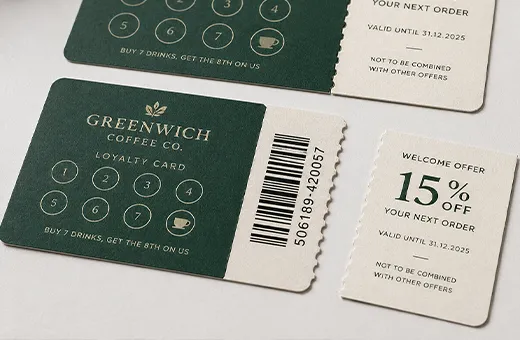
A hybrid card format: a printed gift card with one or several detachable perforated coupons attached along its edge. The recipient (or the giver) tears off the coupon at redemption — the till scans the detached coupon for the voucher amount, the rest of the card stays in the wallet. Two patterns dominate:
- Promotional gift card with single tear-off voucher — the main card carries the brand identity and the gift card balance; a detachable strip below the perforation carries a "first-purchase 20% off" voucher or a "free shipping" coupon, redeemable in one transaction.
- Multi-coupon seasonal card — a paper gift card with a grid of perforated coupons, each with its own value or qualifying offer (e.g. four €25 vouchers, each valid in a different quarter). The customer tears off one coupon per visit; the residual card carries the remaining vouchers.
The detachable format works best on paper substrate where the perforation cuts cleanly and the tear-off action is intuitive. Common on seasonal campaigns (Christmas pack with monthly vouchers), on welcome packs and on cross-product gifting (a gift card valid at three partner brands, one coupon per brand).
5. Encoding choice for gift cards
The encoding decision on a gift card follows the same logic as on a loyalty card — match the POS infrastructure. The dominant patterns:
5.1 unique barcode (EAN-13 or code 128)
The default. A unique 1D barcode printed on the back of the card, scanned at the till for activation, balance check and redemption. EAN-13 for numeric SKU-style identifiers; Code 128 for alphanumeric identifiers that combine letters and digits. See our companion guide barcode cards for business.
5.2 unique QR code
For gift card programmes with a mobile / online redemption journey, a unique QR code on the back of the card opens the retailer's redemption portal, a balance-check page or a deep link into the mobile app. Common on omnichannel programmes where the gift card works both in-store and online with the same identifier.
5.3 magnetic stripe
Some retail POS systems — particularly in older department stores and in hospitality-adjacent retail — read magnetic stripe for gift card processing. The stripe carries the same identifier as the barcode; the choice depends on what your POS scans natively. See our magnetic stripe cards range.
5.4 hybrid (barcode + QR side by side)
For programmes that span in-store and online redemption, printing both an EAN-13 barcode and a QR code on the back of the card gives the cashier and the customer's smartphone independent reading paths. Both encodings resolve to the same identifier server-side; the customer experience adapts to whichever scanner is at hand.
6. Card design and packaging
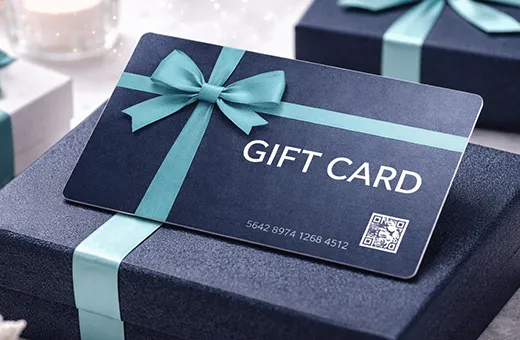
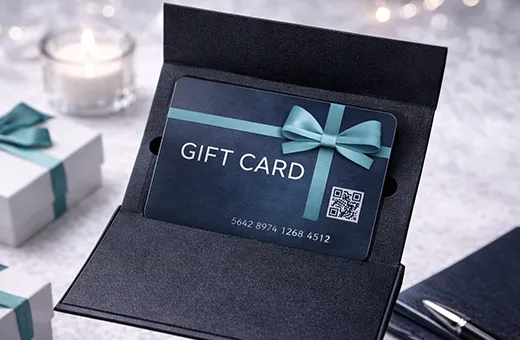
The physical gift card is half the equation. The packaging is the other half — and on many programmes it is the part that actually drives the perceived value. A €50 gift card slipped bare into a paper bag feels nothing like the same card presented in a printed folder with foil branding inside a slim cardboard box.
6.1 card design
The card front carries the brand and the gift card visual identity — typically distinct from the loyalty card design (no member number, no tier indicator, often a more decorative graphic). Premium gift cards use hot foil stamping, spot UV varnish, embossing or metallic ink to reinforce the gifting feel. The back of the card carries the unique barcode (or QR), the scratch-off activation code (if used), the terms and conditions URL, and the brand customer service contact. See our PVC gift cards product page and the finishes and customisation options reference.
6.2 packaging — the formats that work
Five packaging formats cover almost all retail gift card programmes. Each carries the brand and protects the card from view until the recipient opens it:
- Printed sleeve — a flat printed sleeve into which the card slides. The simplest and most cost-efficient packaging. Good for mass-market gift card displays at the till.
- Folded card holder — a folded printed cardboard piece with a slit holding the gift card on one side and a personalised message panel on the other. The default for premium retail and for gift cards intended as a complete giftable object.
- Hanger backer — a printed cardboard piece with a hanging hole for hook-display in the store. Common in supermarkets and large-format retail where the gift card is displayed alongside the till.
- Envelope — a printed envelope sized for the ID-1 card, often with a discreet branded interior. Common for hospitality gift cards delivered by mail or by hand at reception.
- Rigid presentation box — a printed cardboard or rigid box for premium gift cards (€100+, executive gifting, hospitality high-value). The most premium feel, the highest unit cost. Common in luxury retail and premium hospitality.
The full range of packaging options is detailed on our gift card packaging page. The right choice balances unit cost, brand positioning and the typical gifting moment for your customers.
7. Anti-fraud features
Gift cards carry real money in a printed plastic shell that sits unattended on retail displays. The fraud risk is real, known to gift card platforms and addressable with a small toolkit of production-side features. See our broader companion guide secure card printing options for the full security framework.
7.1 scratch-off activation code (the standard)
As covered in section 3.3, a scratch-off layer over a short activation code on the back of the card prevents pre-activation fraud — the most common gift card attack pattern. This is the single most effective production-side anti-fraud feature for retail gift cards and is standard on most professional programmes.
7.2 unique barcode per card (mandatory)
Every card carries a different barcode payload. Even if a counterfeiter reproduces the visible card body, the duplicated barcode either does not exist in the platform (the card never activates) or matches an already-redeemed card (the system rejects the second scan). Single-card traceability is the foundation of gift card security.
7.3 tamper-evident lamination
The protective lamination over the printed surface bonds permanently to the PVC body. Any attempt to delaminate the card (to alter the printed value or activation code) leaves visible disturbance. Standard on all PVC gift cards.
7.4 visible deterrents (foil, spot UV)
Hot foil stamping and spot UV varnish are not anti-fraud features in the strict sense, but they raise the visible quality threshold that a casual counterfeiter would need to match. A foil-stamped gift card on premium PVC is materially harder to reproduce credibly at home printer quality than a flat CMYK card.
8. Substrate choice — PVC, bio-PVC or paper
8.1 standard PVC — the retail reference
The dominant substrate for retail gift cards across Europe. ISO 7810 ID-1 format, durable enough to survive months in a wallet between purchase and full redemption, compatible with hot foil, spot UV, scratch-off ink and magnetic stripe encoding. The right choice for any gift card programme where perceived value matters. See PVC gift cards.
8.2 Bio-PVC — the eco upgrade
For retail brands with a sustainability story to tell, bio-PVC is the practical upgrade. Same chemistry as standard PVC (same printability, same durability, same scratch-off and barcode behaviour at the till), but a portion of the raw material is sourced from renewable biomass (sugarcane-derived bio-ethanol) instead of fossil hydrocarbons. The carbon footprint at production is reduced; the in-wallet experience is indistinguishable from standard PVC. A natural choice for organic, natural beauty and eco-positioned retailers. See our companion article are PVC cards recyclable.
8.3 paper gift cards — cost-efficient, seasonal and detachable-coupon friendly
For seasonal campaigns (Christmas, Mother's Day, Valentine's Day, summer promotions), for entry-level value cards (€10, €15, €20), or for retailers prioritising sustainability over durability, a paper gift card on coated, uncoated or recycled stock is the right choice. Lower unit cost than PVC, fully POS-scannable, and naturally biodegradable at end-of-life.
Paper gift cards also unlock production features that PVC cannot easily deliver:
- Detachable perforated coupons — clean tear-off perforations are a natural fit for paper substrate. The hybrid "gift card + voucher" format (section 4.4) is dominantly produced on paper.
- Soft-touch lamination — a velvety tactile finish only available on paper, often used on premium seasonal gift cards (Christmas, Mother's Day).
- Embossing and debossing — tactile raised relief on logos or denomination markers, common on premium paper gift cards.
- FSC and recycled stocks — naturally FSC-certified options for retailers with strong environmental positioning.
Paper gift cards are increasingly common in beauty retail, bookshops, food and grocery campaigns, and any seasonal moment where the gift card lifecycle is measured in weeks rather than months. The combined paper substrate + detachable coupon format is particularly popular for promotional gifting (welcome gifts, brand events, multi-store campaigns).
8.4 choosing the right substrate
- PVC — premium retail, high-value gift cards (€50+), multi-month wallet lifecycle. The default.
- Bio-PVC — same use cases as PVC, plus a sustainability brand story. Eco beauty, organic food, fashion with green positioning.
- Paper gift card — seasonal campaign, entry-level value (€10–€25), recyclable, short-cycle. Beauty, books, food, promotional retail.
9. Programme types — seasonal vs evergreen
9.1 evergreen gift card programme
The gift card design lives on the till display year-round, with a stable visual identity matching the brand. Same artwork, same values, same packaging across the year. Operationally simple, lower unit cost (large production runs), the foundation of most retail gift card programmes. Replenishment runs every few months based on actual sales velocity.
9.2 seasonal gift card programme
Limited-edition gift card designs released for specific moments: Christmas, Valentine's Day, Mother's Day, Father's Day, summer holidays, back-to-school. Each campaign has its own artwork, often its own packaging, sometimes its own price points. Seasonal cards drive higher average ticket value than evergreen (the seasonal moment justifies a premium) and create collectible momentum among repeat gifters. Production timing follows the campaign calendar; planning starts 8 to 12 weeks before the campaign launch date.
9.3 promotional / loyalty-tied gift cards
Gift cards issued as a reward inside a loyalty programme — earn-by-spend conversion, birthday gift, welcome gift, anniversary card. The gift card carries the loyalty programme branding and the same encoding stack as a standard gift card. Distribution is targeted (only members receive it) rather than open-display.
10. Sector-specific guidance
10.1 fashion and apparel
Premium PVC gift cards with hot foil branding and a folded card holder packaging. €50, €100, €150 are the typical denominations. Seasonal designs at major gifting moments. The card design typically picks up the seasonal campaign artwork.
10.2 beauty and cosmetics
PVC or paper gift cards with strong scratch-off activation (often combined with a personalised digital flow for redemption). Higher seasonal volume than fashion — beauty gift cards are a year-round category. Bio-PVC pairs naturally with natural and organic positioning. See our beauty and wellness industry page.
10.3 restaurants and hospitality
Multi-use / reloadable PVC gift cards with magnetic stripe or barcode encoding, frequently paired with a printed envelope or a folded holder for table presentation. Hotel gift cards often go up to €500+ for weekend gift packages. See our hospitality industry page.
10.4 supermarkets and grocery
PVC gift cards in a hanger backer for till-side display, sold in fixed denominations (€10, €25, €50, €100). High volume, low ticket on average, standard barcode encoding. Scratch-off activation is standard. Often part of a multi-brand gift card mall (the retailer hosts gift cards from other brands alongside its own).
10.5 bookshops and specialty retail
PVC or paper gift cards in a folded card holder. Lower volume than supermarkets but higher engagement — the gift card is often part of a curated giftable selection. Standard barcode, no magnetic stripe. Paper gift cards are increasingly popular in eco-positioned bookshops.
10.6 department stores
Premium PVC gift cards in printed envelopes or rigid presentation boxes for higher value bands. Multi-departmental redemption — one gift card valid across cosmetics, fashion, home, dining. Magnetic stripe encoding on older POS systems; barcode + QR on modern ones. The card design typically reflects the institutional brand identity.
10.7 spa, wellness and beauty services
PVC gift cards for treatment vouchers — single treatment, day pass, weekend stay. Higher unit value than retail gift cards. Folded card holder or printed envelope packaging. See our beauty and wellness industry page.
11. Common pitfalls to avoid
- No scratch-off on the activation code — leaves the programme exposed to pre-activation fraud. Always specify scratch-off ink over the activation code.
- Identical barcodes across cards — defeats single-card traceability. Variable data printing must produce unique barcodes per card.
- Packaging treated as an afterthought — a great gift card in a generic plastic bag loses 80% of the gifting feel. Plan packaging at the same time as the card design.
- Barcode too small or under glossy lamination — read failures at the till slow the transaction and frustrate cashiers. Specify matte lamination over the barcode area and use the recommended X-dimension.
- Validity period not printed on the card — leaves recipients uncertain about expiration. Print the validity duration or "no expiry" prominently on the back.
- Seasonal cards produced too late — Christmas cards arriving in December are 6 weeks too late for the November activation wave. Production should be complete by mid-October for the Christmas campaign.
- Sustainability claim without substrate to back it — claiming "eco-friendly" on a standard PVC gift card is misleading. If your brand positions on sustainability, the card has to align — bio-PVC, recycled PVC or paper.
- Mixed denominations on the same artwork — printing the same artwork for €25 and €100 cards is fine; printing the denomination on the card itself locks the unit and creates wasted stock. Keep the denomination off the printed card and set it at activation.
12. Frequently asked questions
What is the minimum order for a retail gift card programme?
100 cards minimum on PVC, 100 cards minimum on paper. For independent retail launches, the initial batch is typically 200 to 1 000 cards. For chain rollouts and seasonal campaigns, volumes range from a few thousand cards to several hundred thousand depending on store count and expected sales velocity.
Should the gift card show the denomination on the card itself?
Generally no. Setting the denomination at activation (rather than printing it on the card) gives operational flexibility: the same card stock works for €10, €25, €50 and €100 cards, the cashier sets the value at the till, and you avoid wasted stock if one denomination sells faster than another. The exception is fixed-value premium gift cards (€100, €250) where the denomination is part of the design and the perceived value.
Is scratch-off activation worth the extra production cost?
Yes, for any gift card programme with open-display sale (cards visible on a till-side rack or a hanger display). The added unit cost is minimal compared to the fraud exposure of unprotected activation codes. The exception is gift cards sold only in sealed envelopes or behind the counter, where the physical access to the code is already controlled.
Can the same card work for in-store and online redemption?
Yes, and it is increasingly the standard. The barcode (or QR) maps to a single identifier in your gift card platform; the platform resolves whether the redemption is in-store (POS scan) or online (web checkout). One physical card, two redemption paths, one shared balance.
Are paper gift cards as durable as PVC for the typical gifting cycle?
For seasonal and short-cycle campaigns — yes. A paper gift card on coated 350 to 400 gsm stock comfortably survives the weeks between purchase and redemption that characterise gift card use. For multi-month or multi-year reloadable cards, PVC remains the right choice for durability. The choice depends on the expected lifecycle of the specific card programme.
How fast can a gift card project be produced?
PVC gift cards: 6 to 10 working days standard production. Paper gift cards: 4 to 6 working days standard; shorter lead times may be possible depending on the production schedule. Custom packaging (folded holder, sleeve, rigid box) adds 2 to 6 working days depending on complexity. See our delivery times page.
Can gift cards be co-branded with another brand?
Yes. Co-branded gift cards are common — a retailer card co-branded with a bank for cashback, a hotel card co-branded with an airline for travel rewards, a beauty retailer card co-branded with a magazine for editorial gifting. The artwork includes both brand logos; the encoding maps to the issuing system. Technically identical to a single-brand gift card, only the design coordination is different.
What happens to unspent gift card balances?
The unspent portion is called breakage. It is governed by your gift card platform's rules and by the validity terms printed on the card or in the linked T&Cs. Typical patterns: the balance remains accessible until the validity expires (often 12 to 36 months from activation); after expiry, the remaining balance is recognised as revenue in the retailer's accounts. Local consumer protection rules apply — some EU markets restrict the right to expire small balances.
13. Next steps
The decision path for a retail gift card programme is short:
- Define the programme type (evergreen, seasonal, promotional / loyalty-tied) and the denominations.
- Pick the encoding that matches your POS (barcode default; QR if mobile-led; magnetic stripe for legacy POS).
- Pick the substrate (PVC for multi-month; bio-PVC for sustainability story; paper for short-cycle / seasonal).
- Specify anti-fraud features (scratch-off activation code is standard; serialised unique barcode is mandatory).
- Plan the packaging (sleeve, folded holder, hanger backer, envelope, rigid box).
- Schedule the production with the campaign timing in mind (seasonal cards need a 6-8 week lead window).
- Share the spec with our team for a tailored quotation — typically returned within one business day.
Related articles
- Loyalty Cards for Retail: Programme Design Guide
- How Loyalty Cards Work: Mechanics & Best Practices
- Barcode Cards for Business: A Practical Guide
- Secure Card Printing: Options to Prevent Counterfeiting
- Variable Data Card Printing: From CSV to Card
- Are PVC Cards Recyclable? Materials & Alternatives
- PVC Cards vs Paper Cards: Which Material to Choose?
Talk to a custom card specialist
Ready to launch a retail gift card programme?
Share your denominations, your POS setup, your packaging preference and your seasonal calendar — we will return a tailored quotation with the right substrate, encoding, anti-fraud features and packaging combination, calibrated to your launch volume.