
Use cases & programme design · 11 min read
Membership cards for gyms & clubs
A membership card is the physical token of belonging — to a gym, a sports club, a private association, a cultural venue. Unlike a loyalty card (which records purchase history) or a gift card (which carries monetary value), a membership card carries identity and access rights: who you are, what tier you belong to, what doors you can open, what hours you can come in. This guide covers encoding choices for door access, photo personalisation, tier signalling, renewal cycles, durability in demanding environments and the design decisions that turn a generic plastic card into a credential members are proud to carry.
1. Short answer: the three configurations that dominate gym memberships
Most gym and sports club membership cards across Europe fall into one of three product configurations, picked to match the access control system, the membership lifecycle and the operational workflow at the front desk. Each is built on a PVC card in ISO ID-1 format — what changes is how the card is encoded, personalised and reissued.
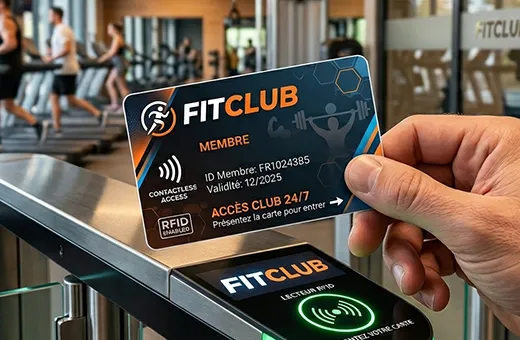
- Configuration 1 — Contactless smart card. A PVC card with an embedded chip (Mifare DESFire, NTAG NFC, or a legacy EM Marin antenna) that opens the door at the turnstile by tap. No printed photo, no member number on the face — the chip is the credential, the access control system identifies the member. Common in 24-7 chain gyms and self-service fitness clubs where the card is purely an access token.
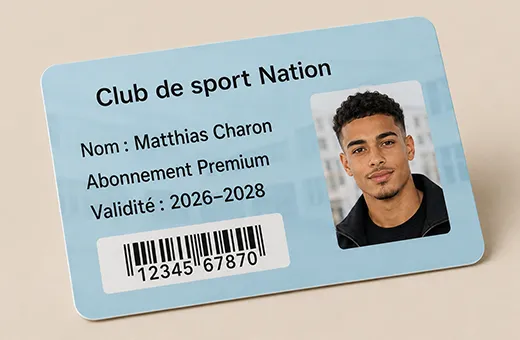
- Configuration 2 — Photo card with unique barcode. A PVC card carrying the member's face photo, name, member number and a unique barcode, all printed as variable data card-by-card. Reception staff verify identity visually; the barcode is scanned for check-in and for cashless purchases at the bar or the café. Common in sports clubs, multi-activity centres and any venue where staff-attended verification is part of the operational flow.
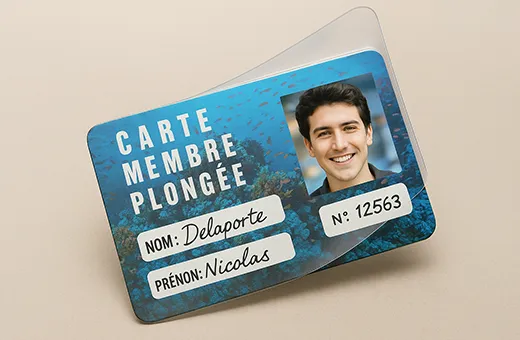
- Configuration 3 — Card with adhesive overlay + variable barcode. A PVC card with a pre-glued transparent adhesive overlay that protects a freshly-printed variable barcode. The barcode can be printed in-house at the front desk on demand — new member, replacement card, renewed validity — without sending the card back to production. The most flexible configuration for clubs that manage their own card issuance.
The three configurations are not mutually exclusive — a premium gym chain often combines them (chip access for entry, photo identity for verification, optional overlay for on-the-spot reissue). The right starting point depends on your access control infrastructure and how much issuance flexibility the front desk needs.
2. What a membership card actually does
A membership card serves three functions that work together to make the membership feel real and operational.
- Access credential — the encoded chip opens the door at the turnstile, the gate at the parking, the reader at the studio entrance. Without the card, the member cannot enter; with the card, the entry is automatic.
- Identity document — the printed photo, name and member number let staff confirm "yes, this is a member" at reception or at any check-point where a chip reader is not available. The visual identity is what protects against simple card-sharing.
- Brand and tier signal — the card design, the finishing and the tier indicator communicate which level of membership the bearer holds, both to staff (to deliver tier-specific benefits) and to other members (to reinforce the value of the upgrade).
For the full product range and specifications, see our membership cards page. For the broader access control discussion across the corporate and education sectors, see our what is a smart card companion article.
3. Access control — the chip families (configuration 1 in detail)
The chip on the card is what makes the door open. This is the technical heart of Configuration 1 — contactless smart card: the card has no printed identifier other than the brand, and the chip is the entire access credential. The choice of chip family is dictated by the access control system already deployed at your venue — the reader at the turnstile, the controller behind it, the credentialing software that provisions the cards. The right chip is the one your existing readers can decode.
3.1 Mifare DESFire EV2 / EV3 — modern secure access
The current reference for new gym and club deployments. AES-128 encryption, mutual authentication, multi-application support (you can host both access and a cashless cafeteria credit on the same chip). Not practically cloneable when properly configured. The right choice if you are launching a new club or upgrading from an older system. See our smart cards product page.
3.2 Mifare Classic 1K / 4K — established mid-range
Widely deployed in older gym chains and sports facilities. Functional, fast, well-supported by reader manufacturers — but with known cryptographic vulnerabilities (Crypto-1) that make it unsuitable for high-security new deployments. Acceptable for legacy compatibility; not recommended for new builds.
3.3 EM Marin 4xxx — 125 kHz legacy access
The historical standard for proximity access cards. Read-only identifier, no encryption, very inexpensive — the chip cost is minimal. Still common in older clubs and sports facilities where the reader infrastructure has not been upgraded. Functional, but the security level is low (the ID is trivially copyable). The right choice when matching existing legacy readers.
3.4 NTAG (NFC) — smartphone-friendly
NFC Forum Type 2 chips read natively by smartphones. Less common as the primary access credential (NTAG security is lower than DESFire), but excellent as a secondary channel for engagement — the card can carry an NTAG that opens a member portal when the phone taps the card, alongside the primary access chip.
3.5 the match-the-reader rule
The fastest way to identify the right chip family is to ask your access control supplier (or to share with us the reader model). Each reader is keyed to specific chip families, frequencies and protocols. Producing cards with the wrong chip family means the cards simply do not work at the door — a failure mode that is detectable only at first use, when the entire batch is already at the club. Validating chip + reader compatibility on a sample card before the full run is standard procedure.
4. Tier design and visual signalling
Most gym and club membership programmes have multiple tiers — Classic / Premium / Platinum, or Bronze / Silver / Gold, or Day / Off-peak / 24-7. The card carries the tier identity visually so that staff at reception, other members in the changing room and the holder themselves all recognise which level of benefit applies.
4.1 foil colour as the tier signal
The dominant tier signal: the brand name or the tier label printed in hot foil stamping, with the foil colour changing by tier (gold for Gold, silver for Silver, copper for Bronze, rose-gold or holographic for Platinum). Immediately recognisable, no ambiguity, no need for a colour blob to communicate the tier. See our finishes and customisation options.
4.2 card stock as the tier signal
Premium tiers often use a distinct stock — black-core PVC for Black-tier cards, frosted PVC for Crystal-tier, metallic ink for "Founder" cards. The card stock change is rarer but reinforces the tier distinction at a tactile level. Best reserved for the top one or two tiers where the production cost difference can be absorbed.
4.3 printed tier indicator
The tier name printed directly on the card front ("Gold Member", "Premium 2024", "Platinum") is the simplest tier signal. Often combined with the foil colour to produce a double signal. Useful at reception where staff can read the tier quickly without scanning the chip.
4.4 photo + name + member number
Independent of tier, every membership card carries the member's photo, name and unique member number. These three fields are the identity foundation — without them, the card is just a generic credential, not a personal one. Variable data printing produces a unique card per member from a structured CSV exported from your membership management system. See variable data card printing.
5. Photo personalisation and identity (configuration 2 in detail)
The face photo is the foundation of Configuration 2 — photo card with unique barcode. It is the single most powerful anti-sharing feature on a membership card: a determined sharer can swap two cards between friends; they cannot easily swap their faces. Reception staff at the gym door check the photo against the person presenting the card, and the visual mismatch (when present) is detected immediately. The unique barcode printed alongside the photo handles check-in scanning and cashless purchases at the club bar or café.
5.1 capturing photos at enrolment
Two workflows dominate:
- On-site capture at enrolment — when a member joins, the front desk takes a photo with a webcam or a simple camera, crops it to the card format (typically 300 × 400 px at 300 dpi), names the file with the member ID, and saves it to the photo folder. The next card production batch picks up the new photos.
- Member-supplied photo — the member submits a photo through the online enrolment form or a dedicated portal. The system validates the photo (size, format, no background, clear face) before queuing the card production.
5.2 photo specifications
Recommended: JPG or PNG, 300 dpi, ~300 × 400 px at the printed card size, white or light grey background for batch consistency, frontal head shot. Off-spec photos (low resolution, busy backgrounds, profile shots) produce inconsistent card quality and are filtered out at the file intake stage.
5.3 batch production with photos
The data file (CSV) lists one row per member with columns for member ID, name, tier, photo filename and any additional variable fields. The photo folder is supplied alongside, with one image per row. The production pipeline composes each card from the constant layout plus the per-row variables (printed photo, name, tier, member number) and encodes the chip in sync. The output is a verified batch with one unique card per member.
5.4 adhesive overlay for on-demand variable barcode printing (configuration 3)
The third dominant configuration solves a specific operational problem: many clubs need to issue cards at the reception desk, on the spot — new member arriving on a Saturday afternoon, replacement card for a lost one, renewed validity at the start of a new season. Sending the card back to production for variable data printing is impractical. The solution is the adhesive overlay configuration.
The card is produced in two layers:
- Pre-printed PVC body — the brand identity, the club name, the design and any static element are printed in advance in large batches, with a blank zone reserved for the variable barcode (and optionally for the member name and number).
- Pre-glued transparent adhesive overlay — a thin transparent film, peelable on one side, applied over the variable zone. At reception, the staff prints the unique barcode (and optionally the name and number) onto the blank zone with a standard card printer, peels the overlay backing and seals the printed area under the protective film.
The advantages are operational: zero lead time for new or replacement cards (issuance happens at the desk in seconds), blank cards stock cheaply on a shelf until they are issued, and the protective overlay seals the printed barcode against wear and casual scratching. The trade-off is that the on-site printer has lower resolution than industrial card printing, so photo personalisation is generally not part of this configuration — the adhesive overlay is best suited for cards where the variable element is the barcode and (optionally) text.
Configuration 3 is particularly common in independent gyms and small chains where the front desk is a single point of contact for enrolment, renewal and replacement, and in clubs whose access control system reads barcode rather than chip (legacy POS infrastructure repurposed as access verification).
6. Material choice for daily wear
Gym and sports club cards are among the most demanding membership use cases in terms of durability. The card is touched and tapped several times per visit, often dropped on a damp floor, repeatedly slipped into and out of a wallet or a sports bag pocket, occasionally left in a sweaty pocket or sun-exposed in a car.
6.1 standard PVC 0.76 mm — the reference
ISO 7810 standard. Handles 2 to 5 years of multi-weekly gym visits comfortably. Lamination protects the printed surface from scratches and moisture. The default choice for most gym and club programmes — see our membership cards product page.
6.2 Bio-PVC — eco-positioned clubs
For clubs with a sustainability brand story (eco gyms, nature-positioned wellness, mindful sport), bio-PVC offers the same durability, same chip and antenna compatibility, same printability as standard PVC — but a portion of the raw material is sourced from renewable biomass instead of fossil hydrocarbons. The carbon footprint at production is reduced; the daily-use experience is indistinguishable. See are PVC cards recyclable.
6.3 composite PVC — high-flex environments
For very intensive daily wear (combat sport clubs, gym chains with extremely high turnover, outdoor sports facilities), a composite multi-layer PVC stock offers higher resistance to bending and to repeated flexing than standard 0.76 mm. The unit cost is slightly higher; the card lifetime is meaningfully longer. Worth considering for cards that get genuinely punished.
7. Renewal cycles and replacement
Membership cards have a defined life cycle. The card is issued at enrolment, used across the membership duration, collected (or invalidated) at termination, and reissued on renewal or replacement. Three patterns dominate.
7.1 annual renewal with new card
The card carries a printed expiry date ("Valid through 2026" or "Member 2025-2026"). At renewal, the member receives a fresh card with the new validity. The old card is collected or simply expires. This pattern reinforces the renewal moment visually — the new card is a small celebration of the continued membership — but doubles the per-member production cost versus a multi-year card.
7.2 multi-year card with platform-driven validity
The card is issued once and the validity lives in the membership platform, not on the card itself. The chip remains valid as long as the member is in good standing; the platform invalidates the chip access when the membership lapses. This pattern reduces the per-member production cost and works well for chip-led access (the door reader checks the chip's permission, not the printed validity).
7.3 replacement for lost or damaged cards
Lost or damaged cards are replaced on request — typically at the reception desk, with a small replacement fee. The standard pattern: invalidate the old chip in the access system, produce a new card with the same member number (or a new one, depending on the policy) and hand it over. Most clubs maintain a small stock of generic blank cards on-site for immediate replacement, with photo personalisation done on the next scheduled production run.
8. Sub-sectors: gyms, sports clubs, cultural and private clubs
8.1 gym chains and fitness studios
The highest-volume sub-sector. PVC cards with Mifare DESFire EV2/EV3 chips for turnstile access, photo + name + member number printed, tier signalling for premium memberships. Renewal cycle typically multi-year (the chip stays valid in the platform; the printed card is replaced only on damage or tier upgrade).
8.2 sports clubs (tennis, golf, equestrian, sailing)
Smaller volumes than gym chains, higher card unit values (top tiers can warrant rigid presentation boxes and embossed numbering). Annual renewal is more common, with a fresh card design each year that picks up the season's visual identity. For specialised facilities (golf, sailing), the card sometimes carries additional information — handicap, vessel registration — printed alongside the standard identity fields.
8.3 cultural and arts associations (museums, theatres, opera houses)
Patron cards combine identity (photo, name, patron level) with access (chip for member entry, sometimes magnetic stripe for legacy ticketing systems). Strong design discipline — the card is part of the institutional brand. Annual renewal tied to the season calendar.
8.4 private members' clubs
Premium positioning. Hot foil stamping standard, often combined with spot UV or embossing. Dark or black-core stocks for the top tier. Chip-based access to club facilities; signature panel on the back. Limited annual production runs (a few hundred to a few thousand cards). High perceived value per card.
8.5 wellness and spa clubs
PVC cards with chip access to the spa floor, photo + name + tier. Often paired with a separate gift-card programme for treatments (see gift cards for stores). The design typically picks up the wellness brand identity — softer palette, natural finishes, sometimes bio-PVC for the eco-aligned positioning.
8.6 professional and trade associations
Annual member cards with photo, name, member number, validity date and the association's branding. Chip for member-only event access; QR code on the back for the member portal. Higher information density than gym cards (often includes professional category, certification level).
9. Common pitfalls to avoid
- Wrong chip family for the reader — produces cards that simply do not work at the door. Validate chip + reader compatibility on a sample before the full run.
- Low-quality member photos — pixellated, badly cropped or inconsistent-background photos make the card look amateur. Set clear photo specifications at enrolment.
- Tier signal too subtle — a colour blob in the corner is not enough. Use foil colour or distinct stock so the tier is visible at a glance.
- Tier name printed but no visual finish difference — a "Gold" card that looks identical to a "Classic" card defeats the upgrade incentive. The visual signal has to back up the printed tier.
- Member number too small to read — staff at reception still read the number manually in some workflows. 9 to 11 pt typeface is the readable sweet spot.
- Printed expiry date with multi-year chip validity — creates confusion between "the card looks expired" and "the chip still works". Either match the printed validity to the chip lifecycle or omit the printed date entirely.
- Card printed without staff training on the tier benefits — staff at reception are the front line. If they cannot deliver the tier benefit the card represents, the upgrade loses meaning.
- Lamination over the photo causing reflective glare — gloss lamination over a face photo can wash out the print under bright reception lights. Matte lamination over the photo area is the safer choice.
- No replacement stock on-site — when a member loses their card, the wait for replacement frustrates the experience. Keep a small on-site stock of blank cards (or pre-issued spares) for immediate replacement at the desk.
- CSV from the management system not cleaned before production — duplicate member numbers, missing photos, malformed names. Validate the data file before sending it to production. See variable data card printing.
10. Frequently asked questions
Which chip family should i choose for my gym?
The chip family is dictated by the access control system already installed at the gym. Ask your access control supplier (or share the reader model with us): each reader is keyed to specific chip families. Common patterns: Mifare DESFire EV2/EV3 for modern new deployments, Mifare Classic for legacy systems, EM Marin 4xxx for older 125 kHz proximity infrastructure, NTAG for smartphone-friendly applications.
Do members really need a photo on the card?
For most gym and club programmes — yes. The photo is the most powerful anti-sharing feature. Without it, two friends can trivially swap cards; with it, the visual mismatch is detected at reception or anywhere the card is presented manually. The exception is low-friction proximity venues (24-7 unattended gyms) where the chip alone handles access and no human verifies the card.
How long does a gym membership card typically last?
Standard PVC 0.76 mm comfortably handles 2 to 5 years of multi-weekly gym use. Composite or thicker PVC stocks extend this for very intensive environments (combat sport, outdoor facilities). The chip lifetime matches the card body lifetime — there is no separate degradation of the encoded data over time.
Can the same card open the door and pay at the cafeteria?
Yes, on multi-application chip families like Mifare DESFire EV2/EV3 or Java Card. Multiple applications coexist in separate sectors on the same chip — door access in one sector, cafeteria credit in another, locker assignment in a third. Each application has its own keys and reader configuration.
What is the minimum order for a membership card programme?
100 cards minimum. For a club launch, typical volumes range from 200 to 2 000 cards depending on the membership base. For chain rollouts (gym franchises, sports federation national programmes), volumes scale to tens of thousands across multiple sites.
How fast can a membership card project be produced?
PVC membership cards: 6 to 10 working days standard production, 8 to 10 with variable data; shorter lead times may be possible depending on the production schedule. Chip encoding extends production to 8 to 15 working days. See our delivery times page.
Should i print the membership validity date on the card?
For programmes with a fixed renewal cycle (annual sport club membership, season pass) — yes. The printed date reinforces the renewal moment and helps staff and members track expiry. For programmes with rolling or platform-driven validity (chip-led gym access with auto-renew), it is often cleaner to omit the printed date and let the platform manage the chip's permission.
Can i migrate from an old chip family to a new one (e.g. EM Marin to Mifare DESFire)?
Yes, in phases. The standard pattern: issue cards with the new chip to all members at the next natural renewal point; deploy new readers in parallel with the old ones; once new-chip penetration reaches 80-90% of the member base, switch the new reader to default and retire the old readers at the next equipment cycle. A migration typically runs over 12 to 24 months for a mid-sized club.
11. Next steps
The decision path for a membership card programme is short:
- Identify the chip family that matches your access control system (ask the supplier, or share the reader model with us).
- Define the tier structure and the visual signalling (foil colour, distinct stock, printed tier name).
- Set the photo workflow at enrolment (on-site capture or member-supplied with validation).
- Decide on the renewal cycle (annual reissue with new card, or multi-year card with platform validity).
- Prepare a clean CSV with one row per member from your membership management system.
- Share the spec with our team for a tailored quotation — typically returned within one business day.
Related articles
- How Loyalty Cards Work: Mechanics & Best Practices
- Loyalty Cards for Retail: Programme Design Guide
- Gift Cards for Stores: A Revenue-Driving Programme
- What Is a Smart Card? Chip Cards Explained
- Magnetic Stripe vs Smart Cards: Differences That Matter
- Variable Data Card Printing: From CSV to Card
- Secure Card Printing: Options to Prevent Counterfeiting
- Are PVC Cards Recyclable? Materials & Alternatives
Talk to a custom card specialist
Ready to launch a membership card programme?
Share your access control system, your tier structure and your membership volume — we will return a tailored quotation with the right chip family, substrate, finishing and personalisation workflow, calibrated to your renewal cycle.