
The short answer
What a student card programme costs and what we need from you
Figures from our 2026 price list for a student card: 85.6 × 54 mm, 0.76 mm PVC, full colour both sides, gloss laminated, with the student’s photo, name, number and class printed in colour on each card. Indicative, excluding VAT and shipping.
| Minimum order | 50 cards. Schools often add a small reserve (5 to 10 %) for late enrolments and lost cards. |
|---|---|
| 100 cards with photo | around 160 € (about 1.60 € per card) |
| 500 cards with photo | around 310 € (about 0.62 € per card) |
| 1,000 cards with photo | around 410 € (about 0.41 € per card) |
| Encoding | Barcode for the library: included in the printed data. Magnetic stripe: around +25 € per hundred. NFC (NTAG213): around 213 € for 100 cards, 489 € for 500, 767 € for 1,000 including print. Mifare Classic 1K: around 238 € for 100, 609 € for 500. DESFire: on quotation. |
| Holders and lanyards | Soft card holders from about 14 € per 100, lanyards from about 39 € per 100, delivered in the same parcel. |
| What we need | One spreadsheet (name, number, class, validity, photo file name) and a folder of photos (JPG, 300 px wide minimum, any background). We crop and align them. |
| Lead time | 8 to 10 working days after proof approval, then 1 to 3 working days of tracked shipping (2 to 3 to the UK). Order in July for cards on desks in September. |
| Proof | Free digital proof showing several real students from your file, so you check the photo crop and the data before printing. |
Indicative prices, 2026 price list, excluding VAT and shipping. Photo personalisation is included in the prices shown.
What to put on a student card, and what to leave off
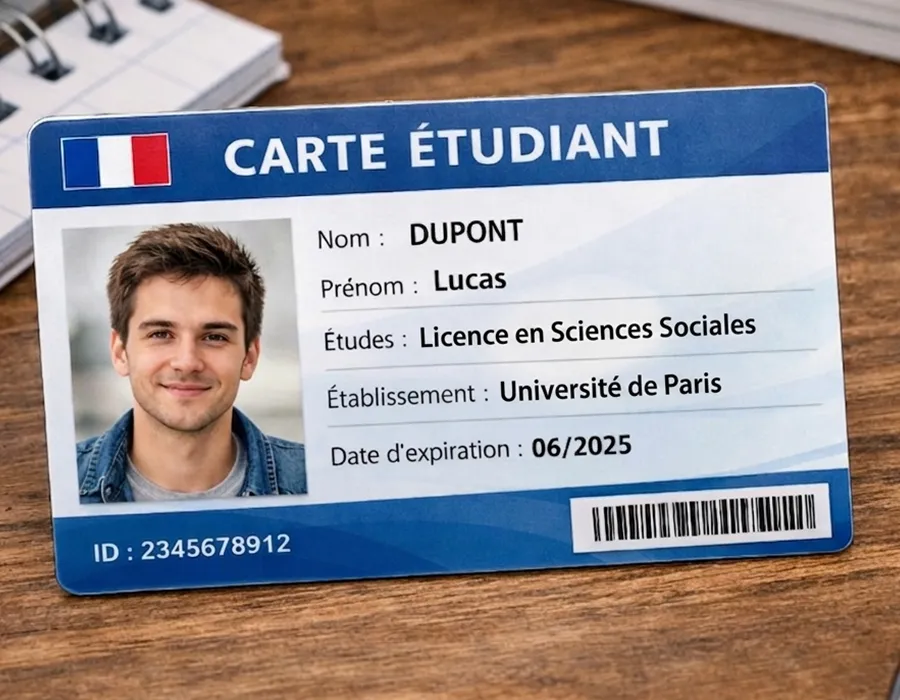
On the front: the school name and logo, the student’s photo, name, class or programme, and the validity year printed large enough to be read by a bus driver or a cinema cashier. On the back: the student number as text and as a barcode if the library uses one, the school address and phone, a return-if-found line, and the legal mention required in your country.
Leave off anything that changes during the year (room, timetable) and anything sensitive (date of birth in full, home address): a lost card should not expose more than it must. Under GDPR, the photo and the name on the card are a legitimate use; keep the data file to the fields printed and delete our copy at the end of the job, which we do by default.
Which encoding for doors, lockers, library and canteen
- Library and attendance: a printed barcode (Code 128 or EAN) or QR code is enough and costs nothing extra; any USB scanner reads it.
- Doors, gates and lockers: the chip must match your readers. Mifare Classic 1K is still the most common in schools; DESFire EV2/EV3 is the secure standard for new installations; NTAG works with NFC phones and simple readers. Send us the reader brand or a working card and we validate the chip before quoting.
- Canteen and payment: most cashless systems use the chip serial number (UID) or a magnetic stripe. We supply the list of UIDs after production so your system can import them.
- Several uses on one card: a chip for doors plus a printed barcode for the library is the usual combination, on a single 0.76 mm card.
Running the yearly renewal
Year one takes the longest: template, data format, photo collection, reader check. From year two, the programme is a file exchange. In June, export the new student list and the new photos (new students only, or everyone if your school re-photographs each year). Send them with the validity year to print. We reuse the approved template, send a proof with a few real students, and deliver before the school year starts. Replacement cards during the year are printed from 50 units, or we keep a small stock of blanks personalised on demand for larger schools.
Tip: print the validity year as a visible element (a coloured band or a large “2026-2027”) rather than a sticker; it costs nothing and avoids the sticker that falls off in October.
Timeline for a September start
- May to June: brief and quotation; reader check if the card must open doors.
- Late June to early July: template approved; photos and list collected.
- July: digital proof with real students approved; production (8 to 10 working days).
- August: delivery to the school, cards sorted by class if you ask for it.
- September: cards on desks; a reserve of 5 to 10 % covers late enrolments.
Late start? Express production in 2 to 4 working days is possible on request, subject to availability when the order is launched; the quotation confirms the date.